
Based on the following reaction profile, how many intermediates are formed in the reaction A¡C? How many transition states are there? Which step, A¡B or B¡C, is the faster? For the reaction A¡C, is ΔE positive, negative, or zero? [Section 14.6]
Ch.14 - Chemical Kinetics
14장, 문제 12d
Consider the diagram that follows, which represents two steps in an overall reaction. The red spheres are oxygen, the blue ones nitrogen, and the green ones fluorine. (d) Write the rate law for the overall reaction if the first step is the slow, rate-determining step. [Section 14.6]

검증된 단계별 안내1
Identify the reactants and products in the first step of the reaction. The first step involves two molecules of O2 reacting to form an intermediate.
Recognize that the first step is the slow, rate-determining step. This means the rate law for the overall reaction will be based on this step.
Write the rate law for the first step. Since the first step involves two O2 molecules, the rate law will be rate = k[O2][O2] or rate = k[O2]^2.
Note that the rate constant (k) is specific to the rate-determining step and the concentrations of the reactants involved in this step.
Combine the information to write the overall rate law for the reaction, which is determined by the slowest step: rate = k[O2]^2.

비슷한 문제에 대한 검증된 영상 답변:
이 영상 해법은 위 문제에 도움이 된다고 튜터들이 추천한 것입니다.
영상 길이:
2m도움이 되었나요?
주요 개념
질문에 올바르게 답하기 위해 반드시 이해해야 하는 핵심 개념들은 다음과 같습니다.
Rate-Determining Step
The rate-determining step is the slowest step in a reaction mechanism that dictates the overall reaction rate. It acts as a bottleneck, meaning that the speed of the entire reaction cannot exceed the speed of this step. Understanding which step is rate-determining is crucial for writing the rate law, as it involves the concentrations of the reactants in that specific step.
추천 영상:
가이드 코스
Rate Law Determination
Rate Law
The rate law expresses the relationship between the rate of a chemical reaction and the concentration of its reactants. It is typically formulated as rate = k[A]^m[B]^n, where k is the rate constant, and m and n are the orders of the reaction with respect to reactants A and B. The rate law can be derived from the rate-determining step, highlighting the reactants involved and their respective stoichiometric coefficients.
추천 영상:
가이드 코스
Rate Law Fundamentals
Elementary Reactions
Elementary reactions are single-step processes that occur in a reaction mechanism. Each elementary reaction has a specific rate law that can be directly derived from its molecularity, which is the number of reactant molecules involved. Understanding elementary reactions is essential for analyzing complex reactions, as they provide insight into how individual steps contribute to the overall reaction mechanism.
추천 영상:
가이드 코스
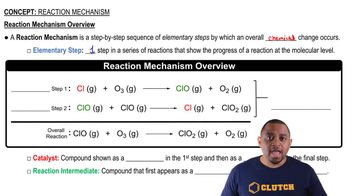
Reaction Mechanism Overview
관련 실천
교과서 질문
1039
views
3
rank
교과서 질문
The accompanying graph shows plots of ln k versus 1>T for two different reactions. The plots have been extrapolated to the y-intercepts. Which reaction (red or blue) has (b) the larger value for the frequency factor, A? [Section 14.5]
780
views
교과서 질문
The following graph shows two different reaction pathways for the same overall reaction at the same temperature. Is each of the following statements true or false? (b) For both paths, the rate of the reverse reaction is slower than the rate of the forward reaction.
1157
views
교과서 질문
The accompanying graph shows plots of ln k versus 1>T for two different reactions. The plots have been extrapolated to the y-intercepts. Which reaction (red or blue) has (a) the larger value for Ea,
706
views
