
Ch.14 - Chemical Kinetics
Brown - Chemistry: The Central Science 14th Edition
Brown14th EditionChemistry: The Central ScienceISBN: 9780134414232당신이 사용하는 게 아니라요?교과서 변경
14장, 문제 9

Hydrogen sulfide (H2S) is a common and troublesome pollutant in industrial wastewaters. One way to remove H2S is to treat the water with chlorine, in which case the following reaction occurs: H2S(aq) + Cl2(aq) → S(s) + 2 H+(aq) + 2 Cl-(aq). The rate of this reaction is first order in each reactant. The rate constant for the disappearance of H2S at 28°C is 3.5 * 10^-2 M^-1 s^-1. If at a given time the concentration of H2S is 2.0 * 10^-4 M and that of Cl2 is 0.025 M, what is the rate of formation of Cl-?

검증된 단계별 안내
1
Step 1: Understand the rate law for the reaction. Since the reaction is first order in each reactant, the rate law can be expressed as: rate = k[H2S][Cl2], where k is the rate constant.
Step 2: Identify the given values. The rate constant k is 3.5 * 10^-2 M^-1 s^-1, the concentration of H2S is 2.0 * 10^-4 M, and the concentration of Cl2 is 0.025 M.
Step 3: Substitute the given values into the rate law equation to find the rate of the reaction: rate = (3.5 * 10^-2 M^-1 s^-1)(2.0 * 10^-4 M)(0.025 M).
Step 4: Recognize that the rate of formation of Cl- is related to the rate of the reaction. According to the balanced chemical equation, 2 moles of Cl- are produced for every mole of H2S that reacts.
Step 5: Calculate the rate of formation of Cl- by multiplying the rate of the reaction by 2, since 2 moles of Cl- are formed per mole of H2S consumed.

주요 개념

질문에 올바르게 답하기 위해 반드시 이해해야 하는 핵심 개념들은 다음과 같습니다.

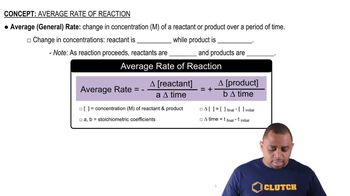
Reaction Rate

The reaction rate is a measure of how quickly reactants are converted into products in a chemical reaction. It is often expressed in terms of the change in concentration of a reactant or product over time. In this case, the rate of the reaction is first order with respect to both H2S and Cl2, meaning that the rate depends linearly on the concentration of each reactant.
추천 영상:
가이드 코스
02:03
Average Rate of Reaction

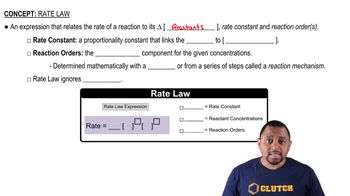
Rate Law

The rate law is an equation that relates the rate of a chemical reaction to the concentration of its reactants, each raised to a power corresponding to its order in the reaction. For the given reaction, the rate law can be expressed as rate = k[H2S][Cl2], where k is the rate constant. This relationship allows us to calculate the rate of formation of products based on the concentrations of the reactants.
추천 영상:
가이드 코스
01:52
Rate Law Fundamentals

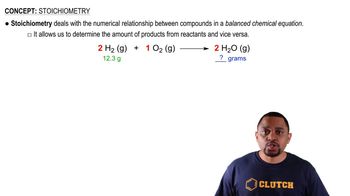
Stoichiometry

Stoichiometry involves the quantitative relationships between the amounts of reactants and products in a chemical reaction. In the provided reaction, the stoichiometry indicates that for every mole of H2S that reacts, two moles of Cl- are produced. This relationship is crucial for determining the rate of formation of Cl- based on the rate of the reaction and the concentrations of the reactants.
추천 영상:
가이드 코스
01:16
Stoichiometry Concept