Ch.15 - Chemical Equilibrium
Brown - Chemistry: The Central Science 14th Edition
Brown14th EditionChemistry: The Central ScienceISBN: 9780134414232당신이 사용하는 게 아니라요?교과서 변경
15장, 문제 91

An equilibrium mixture of H2, I2, and HI at 458 _x001F_C contains 0.112 mol H2, 0.112 mol I2, and 0.775 mol HI in a 5.00-L vessel. What are the equilibrium partial pressures when equilibrium is reestablished following the addition of 0.200 mol of HI?

검증된 단계별 안내
1
Step 1: Write the balanced chemical equation for the reaction. The reaction between hydrogen gas (H2) and iodine gas (I2) to form hydrogen iodide (HI) is: \[ \text{H}_2(g) + \text{I}_2(g) \rightleftharpoons 2\text{HI}(g) \]
Step 2: Calculate the initial concentrations of each species in the 5.00 L vessel. Use the formula \( \text{Concentration} = \frac{\text{moles}}{\text{volume}} \). For example, the concentration of H2 is \( \frac{0.112 \text{ mol}}{5.00 \text{ L}} \). Repeat for I2 and HI.
Step 3: Determine the change in concentration due to the addition of 0.200 mol of HI. Calculate the new concentration of HI by adding the moles of HI added to the initial moles and dividing by the volume of the vessel.
Step 4: Use the reaction quotient \( Q_c \) to determine the direction in which the reaction will shift to reestablish equilibrium. Compare \( Q_c \) with the equilibrium constant \( K_c \) calculated from the initial concentrations.
Step 5: Set up an ICE (Initial, Change, Equilibrium) table to calculate the changes in concentration for each species as the system returns to equilibrium. Use the stoichiometry of the balanced equation to express changes in terms of a single variable, and solve for the equilibrium concentrations.

주요 개념

질문에 올바르게 답하기 위해 반드시 이해해야 하는 핵심 개념들은 다음과 같습니다.

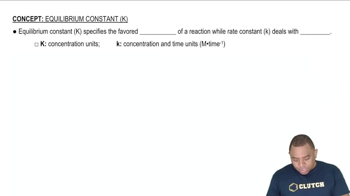
Equilibrium Constant (K)

The equilibrium constant (K) is a numerical value that expresses the ratio of the concentrations of products to reactants at equilibrium for a given reaction at a specific temperature. It is crucial for understanding how changes in concentration affect the position of equilibrium and can be used to calculate the new equilibrium state after a disturbance, such as the addition of a reactant or product.
추천 영상:
가이드 코스
01:14
Equilibrium Constant K

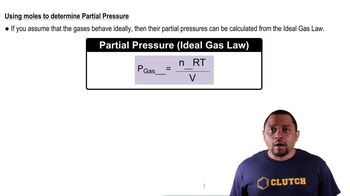
Partial Pressure

Partial pressure is the pressure exerted by a single component of a gas mixture. According to Dalton's Law, the total pressure of a gas mixture is the sum of the partial pressures of each individual gas. In equilibrium calculations, knowing the partial pressures allows for the determination of the equilibrium constant and the shifts in equilibrium position when concentrations change.
추천 영상:
가이드 코스
00:48
Partial Pressure Calculation

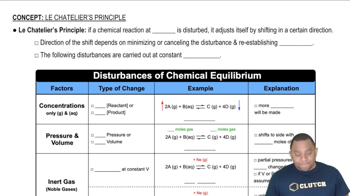
Le Chatelier's Principle

Le Chatelier's Principle states that if a dynamic equilibrium is disturbed by changing the conditions, the system will adjust to counteract the change and restore a new equilibrium. This principle is essential for predicting how the addition of a substance, such as HI in this case, will affect the concentrations of reactants and products in the equilibrium mixture.
추천 영상:
가이드 코스
07:32
Le Chatelier's Principle
관련 실천
교과서 질문

At 700 K, the equilibrium constant for the reaction CCl4(𝑔) ⇌ C(𝑠) + 2 Cl2(𝑔) is 𝐾𝑝 = 0.76. A flask is charged with 2.00 atm of CCl4, which then reaches equilibrium at 700 K. (a) What fraction of the CCl4 is converted into C and Cl2?

교과서 질문

At a temperature of 700 K, the forward and reverse rate constants for the reaction 2 HI(g) ⇌ H2(g) + I2(g) are kf = 1.8×10⁻³⁰ M−1s−1 and kr = 0.063 M−1s−1.

(a) What is the value of the equilibrium constant Kc at 700 K?

(b) Is the forward reaction endothermic or exothermic if the rate constants for the same reaction have values of kf = 0.097M−1s−1 and kr = 2.6 M−1s−1 at 800 K?

298
views
교과서 질문

Consider the hypothetical reaction A(𝑔) + 2 B(𝑔) ⇌ 2 C(𝑔), for which 𝐾𝑐 = 0.25 at a certain temperature. A 1.00-L reaction vessel is loaded with 1.00 mol of compound C, which is allowed to reach equilibrium. Let the variable x represent the number of mol/L of compound A present at equilibrium.

(d) The equation from part (c) is a cubic equation (one that has the form ax3 + bx2 + cx + d = 0). In general, cubic equations cannot be solved in closed form. However, you can estimate the solution by plotting the cubic equation in the allowed range of x that you specified in part (b). The point at which the cubic equation crosses the x-axis is the solution.

(e) From the plot in part (d), estimate the equilibrium concentrations of A, B, and C. (Hint: You can check the accuracy of your answer by substituting these concentrations into the equilibrium expression.)

521
views
교과서 질문

At 700 K, the equilibrium constant for the reaction CCl4(𝑔) ⇌ C(𝑠) + 2 Cl2(𝑔) is 𝐾𝑝 = 0.76. A flask is charged with 2.00 atm of CCl4, which then reaches equilibrium at 700 K. (b) What are the partial pressures of CCl4 and Cl2 at equilibrium?

1262
views