Ch.15 - Chemical Equilibrium
Brown - Chemistry: The Central Science 14th Edition
Brown14th EditionChemistry: The Central ScienceISBN: 9780134414232당신이 사용하는 게 아니라요?교과서 변경
15장, 문제 64

For a certain gas-phase reaction, the fraction of products in an equilibrium mixture is increased by either increasing the temperature or by increasing the volume of the reaction vessel. Does the balanced chemical equation have more molecules on the reactant side or product side?

검증된 단계별 안내
1
Step 1: Understand Le Chatelier's Principle, which states that if a dynamic equilibrium is disturbed by changing the conditions, the position of equilibrium shifts to counteract the change.
Step 2: Consider the effect of increasing temperature on the equilibrium. For an endothermic reaction, increasing temperature shifts the equilibrium towards the products, while for an exothermic reaction, it shifts towards the reactants.
Step 3: Analyze the effect of increasing the volume of the reaction vessel. According to Le Chatelier's Principle, increasing the volume decreases the pressure, and the equilibrium will shift towards the side with more moles of gas to increase the pressure.
Step 4: Since both increasing temperature and volume increase the fraction of products, the reaction is likely endothermic and has more moles of gas on the product side.
Step 5: Conclude that the balanced chemical equation has more molecules on the product side, as both changes favor the formation of products.

주요 개념

질문에 올바르게 답하기 위해 반드시 이해해야 하는 핵심 개념들은 다음과 같습니다.

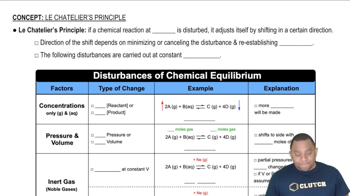
Le Chatelier's Principle

Le Chatelier's Principle states that if a dynamic equilibrium is disturbed by changing the conditions, the system will adjust to counteract the change and restore a new equilibrium. This principle helps predict how changes in temperature, pressure, or concentration will affect the position of equilibrium in a chemical reaction.
추천 영상:
가이드 코스
07:32
Le Chatelier's Principle

Equilibrium Constant (K)

The equilibrium constant (K) is a numerical value that expresses the ratio of the concentrations of products to reactants at equilibrium for a given reaction at a specific temperature. It provides insight into the extent of the reaction and whether the reactants or products are favored in the equilibrium mixture.
추천 영상:
가이드 코스
01:14
Equilibrium Constant K

Molecular Count in Reactions

In a balanced chemical equation, the number of molecules on the reactant side compared to the product side can influence the reaction's response to changes in conditions. If increasing temperature or volume shifts the equilibrium towards products, it suggests that there are fewer molecules on the product side, as systems tend to favor the side with fewer moles to reduce pressure or energy.
추천 영상:
가이드 코스
01:31
Molecularity in Reactions