Ch.15 - Chemical Equilibrium
Brown - Chemistry: The Central Science 14th Edition
Brown14th EditionChemistry: The Central ScienceISBN: 9780134414232당신이 사용하는 게 아니라요?교과서 변경
15장, 문제 66a

Methanol (CH3OH) can be made by the reaction of CO with H2: CO(𝑔) + 2 H2(𝑔) ⇌ CH3OH(𝑔) (a) Use thermochemical data in Appendix C to calculate ΔH° for this reaction.

검증된 단계별 안내
1
Identify the standard enthalpy of formation (ΔH_f°) for each compound involved in the reaction from Appendix C.
Write the balanced chemical equation for the reaction: CO(g) + 2 H_2(g) ⇌ CH_3OH(g).
Use the formula for the standard enthalpy change of the reaction: ΔH° = Σ(ΔH_f° of products) - Σ(ΔH_f° of reactants).
Substitute the ΔH_f° values for CH_3OH(g), CO(g), and H_2(g) into the formula. Remember that the ΔH_f° for elements in their standard state, like H_2(g), is zero.
Calculate the sum of the enthalpies for the products and the reactants separately, then find the difference to determine ΔH° for the reaction.

비슷한 문제에 대한 검증된 영상 답변:

이 영상 해법은 위 문제에 도움이 된다고 튜터들이 추천한 것입니다.
영상 길이:
3m

주요 개념

질문에 올바르게 답하기 위해 반드시 이해해야 하는 핵심 개념들은 다음과 같습니다.

Thermochemical Data

Thermochemical data includes information about the enthalpy changes associated with chemical reactions. This data is often found in tables and can provide standard enthalpy of formation values (ΔH°f) for various substances. By using these values, one can calculate the overall enthalpy change (ΔH°) for a reaction by applying Hess's law, which states that the total enthalpy change is the sum of the enthalpy changes for individual steps.
추천 영상:
가이드 코스
01:13
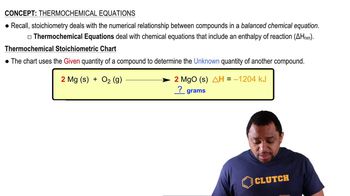
Thermochemical Equations

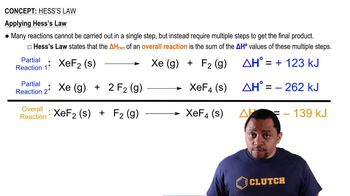
Hess's Law

Hess's Law states that the total enthalpy change for a chemical reaction is the same, regardless of the number of steps or the pathway taken. This principle allows chemists to calculate the enthalpy change of a reaction by summing the enthalpy changes of individual reactions that lead to the same products. It is particularly useful when direct measurement of ΔH° is difficult or impossible.
추천 영상:

Standard Enthalpy of Formation (ΔH°f)

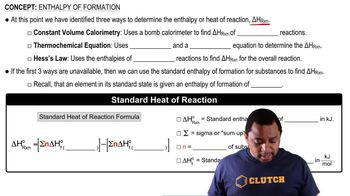
The standard enthalpy of formation (ΔH°f) is defined as the change in enthalpy when one mole of a compound is formed from its elements in their standard states. This value is crucial for calculating the enthalpy change of a reaction using the formula ΔH° = ΣΔH°f(products) - ΣΔH°f(reactants). Understanding how to use ΔH°f values allows for the determination of the energy changes involved in chemical reactions.
추천 영상:
가이드 코스
02:34
Enthalpy of Formation