
Ch.15 - Chemical Equilibrium
Brown - Chemistry: The Central Science 14th Edition
Brown14th EditionChemistry: The Central ScienceISBN: 9780134414232당신이 사용하는 게 아니라요?교과서 변경
15장, 문제 57

For the reaction I2(g) + Br2(g) ⇌ 2 IBr(g), Kc = 280 at 150 _x001F_C. Suppose that 0.500 mol IBr in a 2.00-L flask is allowed to reach equilibrium at 150 _x001F_C. What are the equilibrium concentrations of IBr, I2, and Br2?

검증된 단계별 안내
1
Step 1: Write the balanced chemical equation for the reaction: I2(g) + Br2(g) ⇌ 2 IBr(g).
Step 2: Define the initial concentrations of the reactants and products. Since 0.500 mol of IBr is placed in a 2.00 L flask, the initial concentration of IBr is 0.500 mol / 2.00 L = 0.250 M. The initial concentrations of I2 and Br2 are both 0 M.
Step 3: Set up an ICE (Initial, Change, Equilibrium) table to track the changes in concentrations. Let x be the change in concentration of I2 and Br2 that reacts to form IBr. The changes in concentration will be: I2: +x, Br2: +x, IBr: -2x.
Step 4: Express the equilibrium concentrations in terms of x: [I2] = x, [Br2] = x, [IBr] = 0.250 - 2x.
Step 5: Use the equilibrium constant expression Kc = [IBr]^2 / ([I2][Br2]) = 280 to solve for x. Substitute the equilibrium concentrations into the expression and solve for x to find the equilibrium concentrations of I2, Br2, and IBr.

주요 개념

질문에 올바르게 답하기 위해 반드시 이해해야 하는 핵심 개념들은 다음과 같습니다.

Equilibrium Constant (Kc)

The equilibrium constant (Kc) is a numerical value that expresses the ratio of the concentrations of products to reactants at equilibrium for a given reaction at a specific temperature. For the reaction I2(g) + Br2(g) ⇌ 2 IBr(g), Kc = [IBr]^2 / ([I2][Br2]). A higher Kc value indicates a greater concentration of products at equilibrium.
추천 영상:
가이드 코스
03:20
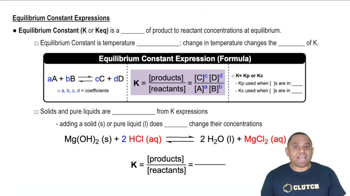
Equilibrium Constant Expressions

Initial Concentration and Changes at Equilibrium

To find the equilibrium concentrations, we start with the initial concentration of IBr and assume that the changes in concentrations of I2 and Br2 are represented by 'x'. The initial concentration of IBr is calculated from the number of moles and volume of the flask, and the changes in concentrations are determined based on the stoichiometry of the reaction.
추천 영상:
가이드 코스
02:10
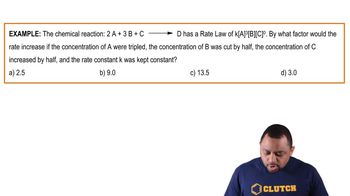
Concentration Changes and Rate Law Example

ICE Table (Initial, Change, Equilibrium)

An ICE table is a tool used to organize the initial concentrations, the changes in concentrations, and the equilibrium concentrations of reactants and products in a chemical reaction. By filling out the ICE table with the initial amounts, the changes (based on the stoichiometry), and solving for equilibrium concentrations, one can systematically determine the concentrations at equilibrium.
추천 영상:
가이드 코스
01:14
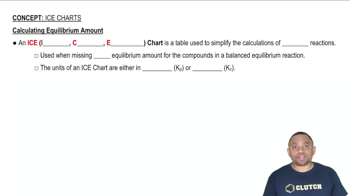
ICE Charts and Equilibrium Amount