
Ch.16 - Acid-Base Equilibria
Brown - Chemistry: The Central Science 14th Edition
Brown14th EditionChemistry: The Central ScienceISBN: 9780134414232당신이 사용하는 게 아니라요?교과서 변경
16장, 문제 113

Many moderately large organic molecules containing basic nitrogen atoms are not very soluble in water as neutral molecules, but they are frequently much more soluble as their acid salts. Assuming that the pH in the stomach is 2.5, indicate whether each of the following compounds would be present in the stomach as the neutral base or in the protonated form: nicotine, Kb = 7 * 10-7; caffeine, Kb = 4 * 10-14; strychnine, Kb = 1 * 10-6; quinine, Kb = 1.1 * 10-6.

검증된 단계별 안내
1
Step 1: Understand the problem by identifying that we need to determine whether each compound is present in the stomach as a neutral base or in its protonated form, given the pH of the stomach is 2.5.
Step 2: Recognize that the protonation of a base in an acidic environment depends on the pH and the base's Kb value. Calculate the pKa for each compound using the relation pKa = 14 - pKb.
Step 3: Compare the pKa of each compound to the pH of the stomach (2.5). If pKa > pH, the compound will be predominantly in its protonated form. If pKa < pH, it will be predominantly in its neutral base form.
Step 4: Calculate the pKa for nicotine using its Kb value: pKa = 14 - (-log(7 * 10^-7)). Repeat this calculation for caffeine, strychnine, and quinine using their respective Kb values.
Step 5: Analyze the results: For each compound, determine if the pKa is greater than or less than the stomach pH of 2.5 to conclude whether it is present as a neutral base or in the protonated form.

주요 개념

질문에 올바르게 답하기 위해 반드시 이해해야 하는 핵심 개념들은 다음과 같습니다.

Acid-Base Chemistry

Acid-base chemistry involves the transfer of protons (H+) between molecules. In this context, basic nitrogen atoms in organic molecules can accept protons, becoming positively charged when protonated. The pH of a solution indicates its acidity or basicity, influencing whether a compound exists in its neutral or protonated form.
추천 영상:
가이드 코스
02:00
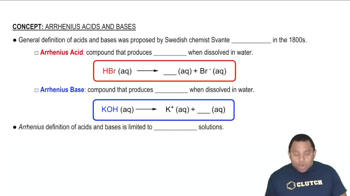
Arrhenius Acids and Bases

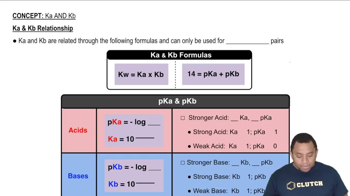
pKa and Kb Relationship

The relationship between pKa and Kb is crucial for understanding the behavior of weak bases in acidic environments. The pKa is the negative logarithm of the acid dissociation constant (Ka), and Kb is the base dissociation constant. By calculating pKa from Kb, one can determine the protonation state of a compound at a given pH, such as the acidic conditions in the stomach.
추천 영상:
가이드 코스
03:01
Ka and Kb Relationship

Solubility of Salts vs. Neutral Bases

The solubility of organic compounds often differs between their neutral and protonated forms. Protonated forms, such as acid salts, are generally more soluble in water due to their ionic nature, while neutral bases may be less soluble. This difference is significant in biological systems, such as the stomach, where the solubility of drugs can affect their absorption and efficacy.
추천 영상:
가이드 코스
02:22
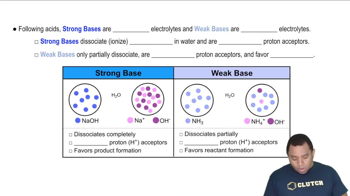
Strong vs Weak Bases