
Ch.19 - Chemical Thermodynamics
Brown - Chemistry: The Central Science 14th Edition
Brown14th EditionChemistry: The Central ScienceISBN: 9780134414232당신이 사용하는 게 아니라요?교과서 변경
19장, 문제 92e

A standard air conditioner involves a refrigerant that is typically now a fluorinated hydrocarbon, such as CH2F2. An air-conditioner refrigerant has the property that it readily vaporizes at atmospheric pressure and is easily compressed to its liquid phase under increased pressure. The operation of an air conditioner can be thought of as a closed system made up of the refrigerant going through the two stages shown here (the air circulation is not shown in this diagram).
During expansion, the liquid refrigerant is released into an expansion chamber at low pressure, where it vaporizes. The vapor then undergoes compression at high pressure back to its liquid phase in a compression chamber. (e) Suppose that a house and its exterior are both initially at 31 °C. Some time after the air conditioner is turned on, the house is cooled to 24 °C. Is this process spontaneous or nonspontaneous?

검증된 단계별 안내
1
Understand the concept of spontaneity: A process is spontaneous if it occurs without needing to be driven by an external force. In thermodynamics, spontaneity is often related to changes in Gibbs free energy (ΔG).
Recall the formula for Gibbs free energy: ΔG = ΔH - TΔS, where ΔH is the change in enthalpy, T is the temperature in Kelvin, and ΔS is the change in entropy.
Consider the air conditioning process: The air conditioner cools the house by transferring heat from the inside to the outside, which involves a decrease in entropy inside the house and an increase in entropy outside.
Analyze the temperature change: The house cools from 31 °C to 24 °C, indicating that heat is being removed from the house, which is an endothermic process (ΔH > 0).
Determine spontaneity: For the process to be spontaneous, ΔG should be negative. Consider the overall entropy change and the energy input required to operate the air conditioner to assess if the process is spontaneous or nonspontaneous.

비슷한 문제에 대한 검증된 영상 답변:

이 영상 해법은 위 문제에 도움이 된다고 튜터들이 추천한 것입니다.
영상 길이:
3m
도움이 되었나요?

주요 개념

질문에 올바르게 답하기 위해 반드시 이해해야 하는 핵심 개념들은 다음과 같습니다.

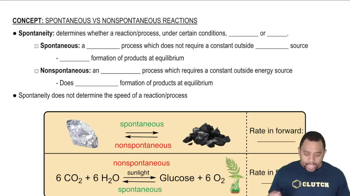
Spontaneity in Thermodynamics

In thermodynamics, a process is considered spontaneous if it occurs naturally without external intervention. This is often determined by the change in Gibbs free energy (ΔG); if ΔG is negative, the process is spontaneous. In the context of cooling a house, the spontaneity relates to whether the system can reach a lower energy state without additional work being done.
추천 영상:
가이드 코스
04:20
Spontaneity of Processes

Phase Changes of Refrigerants

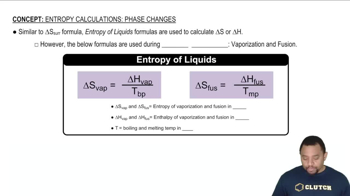
Refrigerants, like CH₂F₂, undergo phase changes between liquid and gas states during the refrigeration cycle. The process involves vaporization, where the liquid absorbs heat and turns into vapor, and condensation, where the vapor releases heat and becomes liquid. Understanding these phase changes is crucial for analyzing how the refrigerant facilitates heat transfer in an air conditioning system.
추천 영상:
가이드 코스
01:46
Entropy in Phase Changes

Heat Transfer and Temperature Change

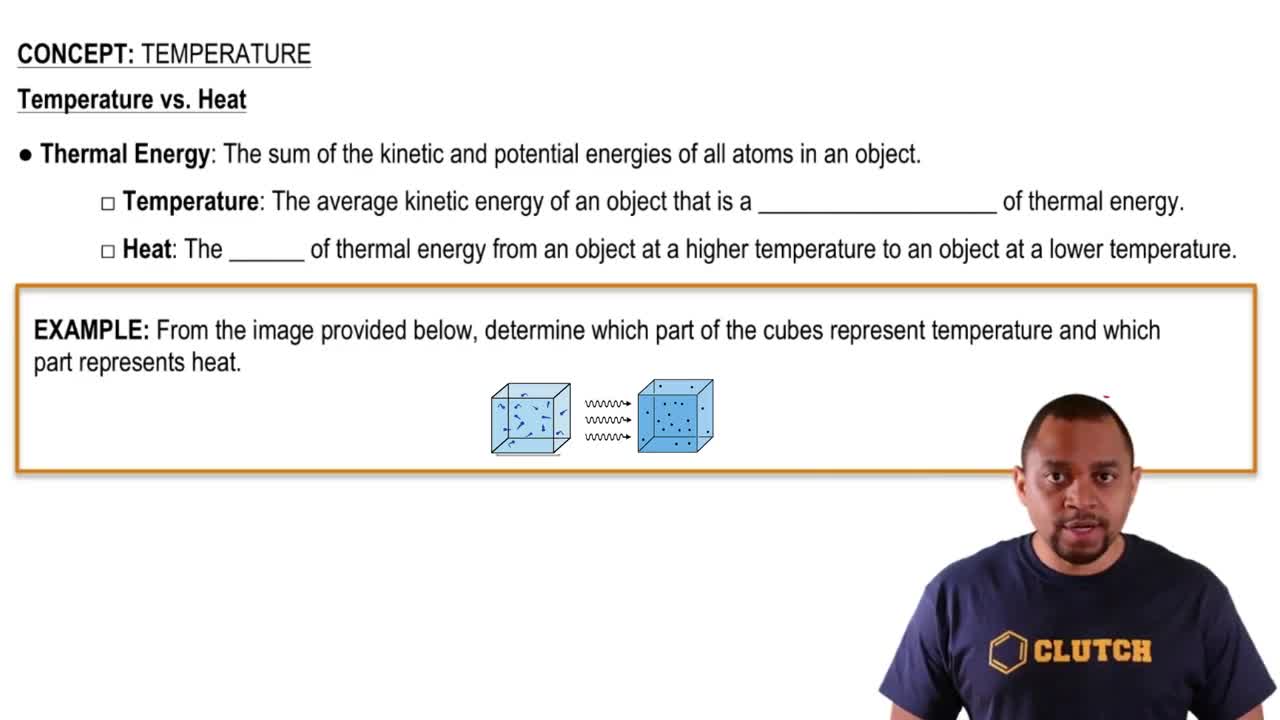
Heat transfer is the movement of thermal energy from one object or system to another, driven by temperature differences. In the air conditioning process, heat is absorbed from the house (cooling it down) and released outside. The temperature change from 31 °C to 24 °C indicates that heat has been removed from the house, which is essential for evaluating the efficiency and effectiveness of the cooling process.
추천 영상:
가이드 코스
03:48
Temperature vs Heat
관련 실천
교과서 질문

A standard air conditioner involves a refrigerant that is typically now a fluorinated hydrocarbon, such as CH2F2. An air-conditioner refrigerant has the property that it readily vaporizes at atmospheric pressure and is easily compressed to its liquid phase under increased pressure. The operation of an air conditioner can be thought of as a closed system made up of the refrigerant going through the two stages shown here (the air circulation is not shown in this diagram).

During expansion, the liquid refrigerant is released into an expansion chamber at low pressure, where it vaporizes. The vapor then undergoes compression at high pressure back to its liquid phase in a compression chamber. (c) In a central air-conditioning system, one chamber is inside the home and the other is outside. Which chamber is where, and why?

375
views
교과서 질문

Trouton’s rule states that for many liquids at their normal boiling points, the standard molar entropy of vaporization is about 88 J/mol‐K. b. Look up the normal boiling point of Br2 in a chemistry handbook or at the WebElements website (www.webelements.com) and compare it to your calculation. What are the possible sources of error, or incorrect assumptions, in the calculation?

2574
views
교과서 질문

(c) In general, under which condition is ΔG°f more positive (less negative) than ΔH°f ? (i) When the temperature is high, (ii) when the reaction is reversible, (iii) when ΔS°f is negative.

582
views
교과서 질문

Consider a system that consists of two standard playing dice, with the state of the system defined by the sum of the values shown on the top faces. (f) Calculate the absolute entropy of the two-dice system.

460
views