

Ch.19 - Chemical Thermodynamics
Brown - Chemistry: The Central Science 14th Edition
Brown14th EditionChemistry: The Central ScienceISBN: 9780134414232당신이 사용하는 게 아니라요?교과서 변경
19장, 문제 93b

Trouton’s rule states that for many liquids at their normal boiling points, the standard molar entropy of vaporization is about 88 J/mol‐K. b. Look up the normal boiling point of Br2 in a chemistry handbook or at the WebElements website (www.webelements.com) and compare it to your calculation. What are the possible sources of error, or incorrect assumptions, in the calculation?

검증된 단계별 안내
1
Identify the normal boiling point of Br2 (bromine) from a reliable source such as a chemistry handbook or the WebElements website.
Calculate the standard molar entropy of vaporization for Br2 using Trouton’s rule, which suggests it should be approximately 88 J/mol-K at the normal boiling point.
Compare the calculated value of the standard molar entropy of vaporization with the value obtained from experimental data or literature.
Analyze possible sources of error in the calculation, such as deviations of Br2 from ideal behavior, experimental errors in measuring boiling point, or inaccuracies in the Trouton's rule approximation for certain types of liquids.
Consider any incorrect assumptions that might have been made in applying Trouton’s rule to Br2, such as ignoring molecular interactions or the specific molecular structure of bromine that could affect its entropy of vaporization.

비슷한 문제에 대한 검증된 영상 답변:

이 영상 해법은 위 문제에 도움이 된다고 튜터들이 추천한 것입니다.
영상 길이:
2m

주요 개념

질문에 올바르게 답하기 위해 반드시 이해해야 하는 핵심 개념들은 다음과 같습니다.

Trouton's Rule

Trouton's Rule states that the standard molar entropy of vaporization for many liquids at their normal boiling points is approximately 88 J/mol·K. This empirical rule helps predict the entropy change associated with the phase transition from liquid to gas, providing a useful benchmark for comparing different substances. Understanding this rule is essential for analyzing the thermodynamic properties of liquids and their vaporization processes.
추천 영상:
가이드 코스
00:28
Solubility Rules

Normal Boiling Point

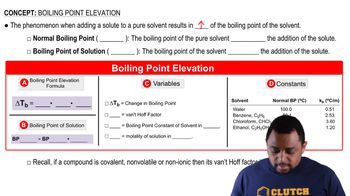
The normal boiling point of a substance is the temperature at which its vapor pressure equals the atmospheric pressure (1 atm). At this point, the liquid phase transitions to the gas phase. Knowing the normal boiling point is crucial for understanding the conditions under which a liquid will vaporize and for applying Trouton's Rule effectively in calculations involving entropy.
추천 영상:
가이드 코스
03:05
Boiling Point Elevation

Sources of Error in Calculations

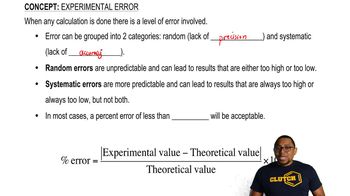
When calculating thermodynamic properties like entropy of vaporization, potential sources of error include assumptions about ideal behavior, inaccuracies in temperature measurements, and variations in atmospheric pressure. Additionally, the presence of impurities or deviations from ideal gas behavior can lead to discrepancies between calculated and observed values. Recognizing these factors is important for critically evaluating experimental results and improving the accuracy of thermodynamic predictions.
추천 영상:
가이드 코스
05:50
Experimental Error
관련 실천
교과서 질문

A standard air conditioner involves a refrigerant that is typically now a fluorinated hydrocarbon, such as CH2F2. An air-conditioner refrigerant has the property that it readily vaporizes at atmospheric pressure and is easily compressed to its liquid phase under increased pressure. The operation of an air conditioner can be thought of as a closed system made up of the refrigerant going through the two stages shown here (the air circulation is not shown in this diagram).

During expansion, the liquid refrigerant is released into an expansion chamber at low pressure, where it vaporizes. The vapor then undergoes compression at high pressure back to its liquid phase in a compression chamber. (c) In a central air-conditioning system, one chamber is inside the home and the other is outside. Which chamber is where, and why?

375
views
교과서 질문

Consider the following three reactions: (i) Ti(s) + 2 Cl2(g) → TiCl4(1g) (a) For each of the reactions, use data in Appendix C to calculate ΔH°, ΔG°, K, and ΔS ° at 25 °C.

312
views
교과서 질문

(c) In general, under which condition is ΔG°f more positive (less negative) than ΔH°f ? (i) When the temperature is high, (ii) when the reaction is reversible, (iii) when ΔS°f is negative.

582
views
교과서 질문

A standard air conditioner involves a refrigerant that is typically now a fluorinated hydrocarbon, such as CH2F2. An air-conditioner refrigerant has the property that it readily vaporizes at atmospheric pressure and is easily compressed to its liquid phase under increased pressure. The operation of an air conditioner can be thought of as a closed system made up of the refrigerant going through the two stages shown here (the air circulation is not shown in this diagram).

During expansion, the liquid refrigerant is released into an expansion chamber at low pressure, where it vaporizes. The vapor then undergoes compression at high pressure back to its liquid phase in a compression chamber. (e) Suppose that a house and its exterior are both initially at 31 °C. Some time after the air conditioner is turned on, the house is cooled to 24 °C. Is this process spontaneous or nonspontaneous?

491
views