Ch.19 - Chemical Thermodynamics
Brown - Chemistry: The Central Science 14th Edition
Brown14th EditionChemistry: The Central ScienceISBN: 9780134414232당신이 사용하는 게 아니라요?교과서 변경
19장, 문제 94c

(c) In general, under which condition is ΔG°f more positive (less negative) than ΔH°f ? (i) When the temperature is high, (ii) when the reaction is reversible, (iii) when ΔS°f is negative.

검증된 단계별 안내
1
Understand the relationship between Gibbs free energy (\( \Delta G^\circ \)) and enthalpy (\( \Delta H^\circ \)) using the equation: \( \Delta G^\circ = \Delta H^\circ - T\Delta S^\circ \).
Identify the condition where \( \Delta G^\circ \) is more positive (or less negative) than \( \Delta H^\circ \). This occurs when the term \( -T\Delta S^\circ \) is positive, which means \( \Delta S^\circ \) must be negative.
Consider the effect of temperature (\( T \)) on the equation. A higher temperature would increase the magnitude of the \( -T\Delta S^\circ \) term, making \( \Delta G^\circ \) more positive if \( \Delta S^\circ \) is negative.
Evaluate the options given: (i) High temperature would make \( \Delta G^\circ \) more positive if \( \Delta S^\circ \) is negative. (ii) Reversibility of the reaction does not directly affect the relationship between \( \Delta G^\circ \) and \( \Delta H^\circ \). (iii) A negative \( \Delta S^\circ \) would directly contribute to \( \Delta G^\circ \) being more positive.
Conclude that the condition where \( \Delta G^\circ \) is more positive than \( \Delta H^\circ \) is when \( \Delta S^\circ \) is negative, especially at high temperatures.

비슷한 문제에 대한 검증된 영상 답변:

이 영상 해법은 위 문제에 도움이 된다고 튜터들이 추천한 것입니다.
영상 길이:
1m

주요 개념

질문에 올바르게 답하기 위해 반드시 이해해야 하는 핵심 개념들은 다음과 같습니다.

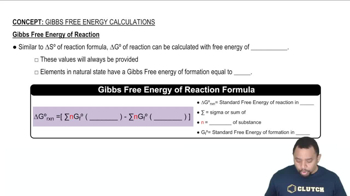
Gibbs Free Energy (ΔG°)

Gibbs Free Energy (ΔG°) is a thermodynamic potential that measures the maximum reversible work obtainable from a thermodynamic system at constant temperature and pressure. It combines the system's enthalpy (ΔH°) and entropy (ΔS°) to determine spontaneity; a negative ΔG° indicates a spontaneous process. Understanding how ΔG° relates to temperature and entropy is crucial for predicting reaction behavior.
추천 영상:
가이드 코스
01:51
Gibbs Free Energy of Reactions

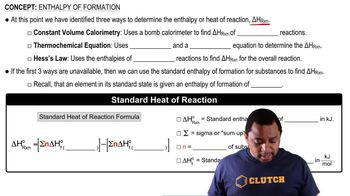
Enthalpy (ΔH°)

Enthalpy (ΔH°) is a measure of the total heat content of a system, reflecting the energy required to create a system at constant pressure. It is a key factor in determining the heat absorbed or released during a chemical reaction. The relationship between ΔH° and ΔG° is essential for understanding how temperature influences reaction spontaneity, particularly when considering the signs of ΔH° and ΔS°.
추천 영상:
가이드 코스
02:34
Enthalpy of Formation

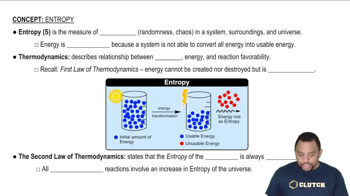
Entropy (ΔS°)

Entropy (ΔS°) is a measure of the disorder or randomness in a system. It plays a critical role in thermodynamics, as it influences the spontaneity of reactions. A negative ΔS° indicates a decrease in disorder, which can lead to a more positive ΔG° at high temperatures, affecting the overall feasibility of a reaction. Understanding the interplay between ΔS° and temperature is vital for analyzing the conditions under which ΔG° becomes less negative.
추천 영상:
가이드 코스
02:46
Entropy in Thermodynamics
관련 실천
교과서 질문

Trouton’s rule states that for many liquids at their normal boiling points, the standard molar entropy of vaporization is about 88 J/mol‐K. b. Look up the normal boiling point of Br2 in a chemistry handbook or at the WebElements website (www.webelements.com) and compare it to your calculation. What are the possible sources of error, or incorrect assumptions, in the calculation?

2574
views
교과서 질문

Consider the following three reactions: (i) Ti(s) + 2 Cl2(g) → TiCl4(1g) (a) For each of the reactions, use data in Appendix C to calculate ΔH°, ΔG°, K, and ΔS ° at 25 °C.

312
views
교과서 질문

Consider the following three reactions: (i) Ti(s) + 2 Cl2(g) → TiCl4(1g) (ii) C2H6(g) + 7 Cl2(g) → 2 CCl4(g) + 6 HCl(g) (iii) BaO(s) + CO2(g) → BaCO3(s) (c) For each of the reactions, predict the manner in which the change in free energy varies with an increase in temperature.

371
views
교과서 질문

Consider the following three reactions: (i) Ti(s) + 2 Cl2(g) → TiCl4(1g) (ii) C2H6(g) + 7 Cl2(g) → 2 CCl4(g) + 6 HCl(g) (iii) BaO(s) + CO2(g) → BaCO3(s) (b) Which of these reactions are spontaneous under standard conditions at 25 °C?

1
views
교과서 질문

A standard air conditioner involves a refrigerant that is typically now a fluorinated hydrocarbon, such as CH2F2. An air-conditioner refrigerant has the property that it readily vaporizes at atmospheric pressure and is easily compressed to its liquid phase under increased pressure. The operation of an air conditioner can be thought of as a closed system made up of the refrigerant going through the two stages shown here (the air circulation is not shown in this diagram).

During expansion, the liquid refrigerant is released into an expansion chamber at low pressure, where it vaporizes. The vapor then undergoes compression at high pressure back to its liquid phase in a compression chamber. (e) Suppose that a house and its exterior are both initially at 31 °C. Some time after the air conditioner is turned on, the house is cooled to 24 °C. Is this process spontaneous or nonspontaneous?

491
views