Ch.19 - Chemical Thermodynamics
Brown - Chemistry: The Central Science 14th Edition
Brown14th EditionChemistry: The Central ScienceISBN: 9780134414232당신이 사용하는 게 아니라요?교과서 변경
19장, 문제 32

(a) Using the heat of vaporization in Appendix B, calculate the entropy change for the vaporization of water at 25 °C and at 100 °C. (b) From your knowledge of microstates and the structure of liquid water, explain the difference in these two values.

검증된 단계별 안내
1
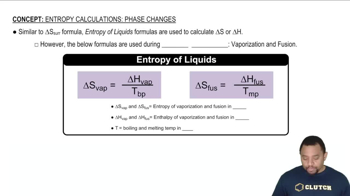
Step 1: Identify the formula for entropy change during vaporization. The entropy change (\( \Delta S \)) for vaporization can be calculated using the formula \( \Delta S = \frac{\Delta H_{vap}}{T} \), where \( \Delta H_{vap} \) is the heat of vaporization and \( T \) is the temperature in Kelvin.
Step 2: Convert the given temperatures from Celsius to Kelvin. Remember that the conversion is \( T(K) = T(°C) + 273.15 \). So, convert 25 °C and 100 °C to Kelvin.
Step 3: Look up the heat of vaporization (\( \Delta H_{vap} \)) for water from Appendix B. This value is typically given in kJ/mol.
Step 4: Calculate the entropy change (\( \Delta S \)) for each temperature using the formula from Step 1. Substitute the values of \( \Delta H_{vap} \) and the converted temperatures into the formula.
Step 5: Discuss the difference in entropy changes at 25 °C and 100 °C. Consider the concept of microstates and the structure of liquid water. At higher temperatures, molecules have more energy and more accessible microstates, leading to a greater increase in entropy upon vaporization.

주요 개념

질문에 올바르게 답하기 위해 반드시 이해해야 하는 핵심 개념들은 다음과 같습니다.

Heat of Vaporization

The heat of vaporization is the amount of energy required to convert a unit mass of a liquid into vapor without a change in temperature. For water, this value varies with temperature, influencing the entropy change during vaporization. At higher temperatures, the heat of vaporization decreases, which affects the thermodynamic calculations of entropy.
추천 영상:

Entropy Change

Entropy change is a measure of the disorder or randomness in a system. When a substance vaporizes, its molecules move from a more ordered liquid state to a less ordered gaseous state, resulting in an increase in entropy. The magnitude of this change can be calculated using the formula ΔS = ΔH/T, where ΔH is the heat of vaporization and T is the temperature in Kelvin.
추천 영상:
가이드 코스
01:46
Entropy in Phase Changes

Microstates and Liquid Water Structure

Microstates refer to the different ways in which a system can be arranged at the molecular level. In liquid water, molecules are closely packed and exhibit hydrogen bonding, leading to fewer accessible microstates compared to water vapor, where molecules are more dispersed. This difference in molecular arrangement explains why the entropy change for vaporization is greater at higher temperatures, as more microstates become available.
추천 영상:
가이드 코스
01:42
Resonance Structures