
Ch.19 - Chemical Thermodynamics
Brown - Chemistry: The Central Science 14th Edition
Brown14th EditionChemistry: The Central ScienceISBN: 9780134414232당신이 사용하는 게 아니라요?교과서 변경
19장, 문제 95b

Consider the following three reactions: (i) Ti(s) + 2 Cl2(g) → TiCl4(1g) (ii) C2H6(g) + 7 Cl2(g) → 2 CCl4(g) + 6 HCl(g) (iii) BaO(s) + CO2(g) → BaCO3(s) (b) Which of these reactions are spontaneous under standard conditions at 25 °C?

검증된 단계별 안내
1
Understand the concept of spontaneity: A reaction is spontaneous under standard conditions if it has a negative Gibbs free energy change (ΔG°). The standard conditions are 25 °C (298 K) and 1 atm pressure.
Use the Gibbs free energy equation: ΔG° = ΔH° - TΔS°, where ΔH° is the change in enthalpy, T is the temperature in Kelvin, and ΔS° is the change in entropy.
Determine the standard enthalpy change (ΔH°) and standard entropy change (ΔS°) for each reaction. These values can be found in standard thermodynamic tables.
Calculate ΔG° for each reaction using the equation ΔG° = ΔH° - TΔS°. Remember to convert temperature to Kelvin by adding 273.15 to the Celsius temperature.
Compare the calculated ΔG° values: If ΔG° is negative, the reaction is spontaneous under standard conditions. If ΔG° is positive, the reaction is non-spontaneous.

비슷한 문제에 대한 검증된 영상 답변:

이 영상 해법은 위 문제에 도움이 된다고 튜터들이 추천한 것입니다.

주요 개념

질문에 올바르게 답하기 위해 반드시 이해해야 하는 핵심 개념들은 다음과 같습니다.

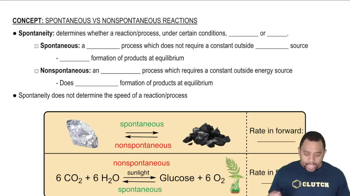
Spontaneity of Reactions

A reaction is considered spontaneous if it occurs without external intervention under standard conditions. This is often determined by the change in Gibbs free energy (ΔG); if ΔG is negative, the reaction is spontaneous. Factors such as enthalpy (ΔH) and entropy (ΔS) changes also play a crucial role in assessing spontaneity.
추천 영상:
가이드 코스
04:20
Spontaneity of Processes

Standard Conditions

Standard conditions refer to a set of specific conditions used to measure and compare the properties of substances, typically defined as 1 atm pressure and a temperature of 25 °C (298 K). Under these conditions, the standard enthalpy and Gibbs free energy of formation can be used to evaluate the spontaneity of reactions, providing a consistent framework for analysis.
추천 영상:
가이드 코스
01:10
Standard Reduction Potentials

Thermodynamic Data

Thermodynamic data, including standard enthalpy of formation (ΔH°f) and standard entropy (S°), are essential for calculating the Gibbs free energy change of a reaction. By using these values, one can determine whether the overall reaction is energetically favorable and thus spontaneous. This data is typically found in tables and is crucial for predicting reaction behavior.
추천 영상:
가이드 코스
01:18
First Law of Thermodynamics