
Ch.19 - Chemical Thermodynamics
Brown - Chemistry: The Central Science 14th Edition
Brown14th EditionChemistry: The Central ScienceISBN: 9780134414232당신이 사용하는 게 아니라요?교과서 변경
19장, 문제 87

Indicate whether each of the following statements is true or false. If it is false, correct it. (a) The feasibility of manufacturing NH3 from N2 and H2 depends entirely on the value of ΔH for the process N2(g) + 3 H2(g) → 2 NH3(g). (e) Spontaneous processes are those that are exothermic and that lead to a higher degree of order in the system.

검증된 단계별 안내
1
Step 1: Understand the concept of feasibility in chemical reactions. Feasibility is determined by the Gibbs free energy change (ΔG), not just the enthalpy change (ΔH). The equation ΔG = ΔH - TΔS shows that both enthalpy (ΔH) and entropy (ΔS) changes, along with temperature (T), affect feasibility.
Step 2: Analyze statement (a). The statement claims that the feasibility of manufacturing NH3 depends entirely on ΔH. Since ΔG, which includes both ΔH and ΔS, determines feasibility, the statement is false. Correct it by stating that feasibility depends on ΔG, not just ΔH.
Step 3: Understand spontaneous processes. A spontaneous process is one that occurs without external intervention. It is characterized by a negative ΔG, which can result from a negative ΔH (exothermic) and/or a positive ΔS (increase in disorder).
Step 4: Analyze statement (e). The statement claims that spontaneous processes are exothermic and lead to a higher degree of order. This is false because spontaneous processes can also be endothermic if they result in a significant increase in entropy (disorder). Correct it by stating that spontaneous processes are those with a negative ΔG, which can be due to exothermic reactions or increased disorder.
Step 5: Summarize the corrections. For statement (a), emphasize the role of ΔG in determining feasibility. For statement (e), highlight that spontaneity is linked to negative ΔG, which can arise from various combinations of ΔH and ΔS.

주요 개념

질문에 올바르게 답하기 위해 반드시 이해해야 하는 핵심 개념들은 다음과 같습니다.

Gibbs Free Energy (ΔG)

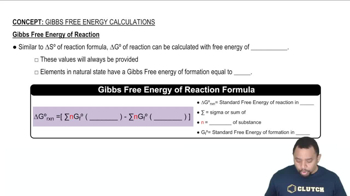
Gibbs Free Energy is a thermodynamic potential that helps predict the spontaneity of a process at constant temperature and pressure. It combines enthalpy (ΔH) and entropy (ΔS) into the equation ΔG = ΔH - TΔS. A negative ΔG indicates a spontaneous process, meaning that the reaction can occur without external energy input, regardless of whether it is exothermic or endothermic.
추천 영상:
가이드 코스
01:51
Gibbs Free Energy of Reactions

Enthalpy (ΔH)

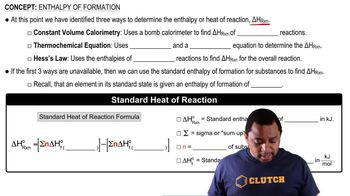
Enthalpy is a measure of the total heat content of a system and is used to understand energy changes during chemical reactions. While ΔH can indicate whether a reaction is exothermic (releases heat) or endothermic (absorbs heat), it alone does not determine the feasibility of a reaction. The overall spontaneity also depends on entropy changes and temperature, making ΔH just one part of the larger picture.
추천 영상:
가이드 코스
02:34
Enthalpy of Formation

Entropy (ΔS)

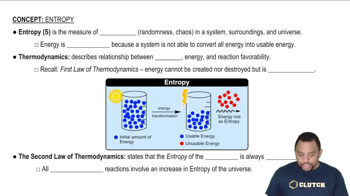
Entropy is a measure of the disorder or randomness in a system. In thermodynamics, spontaneous processes tend to increase the total entropy of the universe. A process can be spontaneous even if it is endothermic (positive ΔH) if the increase in entropy (positive ΔS) is large enough to make ΔG negative. Thus, spontaneity is not solely determined by enthalpy but also by the balance between enthalpy and entropy.
추천 영상:
가이드 코스
02:46
Entropy in Thermodynamics
관련 실천
교과서 질문

For each of the following processes, indicate whether the signs of ΔS and ΔH are expected to be positive, negative, or about zero. (a) A solid sublimes. (b) The temperature of a sample of Co(s) is lowered from 60 °C to 25 °C. (c) Ethyl alcohol evaporates from a beaker. (d) A diatomic molecule dissociates into atoms. (e) A piece of charcoal is combusted to form CO2(g) and H2O(g).

794
views
교과서 질문

The crystalline hydrate Cd(NO3)2⋅4 H2O(s) loses water when placed in a large, closed, dry vessel at room temperature: Cd(NO3)2⋅4 H2O(s) → Cd(NO3)2(s) + 4 H2O(g) This process is spontaneous and ΔH° is positive at room temperature.

(b) If the hydrated compound is placed in a large, closed vessel that already contains a large amount of water vapor, does ΔS° change for this reaction at room temperature?

367
views
교과서 질문

(d) For a reversible isothermal process, write an expression for ΔE in terms of q and w and an expression for ΔS in terms of q and T.

690
views
교과서 질문

The crystalline hydrate Cd(NO3)2⋅4 H2O(s) loses water when placed in a large, closed, dry vessel at room temperature: Cd(NO3)2⋅4 H2O(s) → Cd(NO3)2(s) + 4 H2O(g) This process is spontaneous and ΔH° is positive at room temperature.

(a) What is the sign of ΔS° at room temperature?

교과서 질문

The reaction 2 Mg(s) + O2(g) ⟶ 2 MgO(s) is highly spontaneous. A classmate calculates the entropy change for this reaction and obtains a large negative value for ΔS°. Did your classmate make a mistake in the calculation? Explain.

341
views
교과서 질문

Consider a system that consists of two standard playing dice, with the state of the system defined by the sum of the values shown on the top faces. (f) Calculate the absolute entropy of the two-dice system.

460
views