Ch.19 - Chemical Thermodynamics
Brown - Chemistry: The Central Science 14th Edition
Brown14th EditionChemistry: The Central ScienceISBN: 9780134414232당신이 사용하는 게 아니라요?교과서 변경
19장, 문제 79

Use data from Appendix C to calculate the equilibrium constant, K, and ΔG° at 298 K for each of the following reactions: (a) H2(g) + I2(g) ⇌ 2 HI(g) (b) C2H5OH(g) ⇌ C2H4(g) + H2O(g) (c) 3 C2H2(g) ⇌ C6H6(g)

검증된 단계별 안내
1
Step 1: Identify the standard Gibbs free energy of formation (ΔG°f) for each reactant and product from Appendix C for each reaction at 298 K.
Step 2: Calculate the standard Gibbs free energy change (ΔG°) for each reaction using the formula: ΔG° = Σ(ΔG°f of products) - Σ(ΔG°f of reactants).
Step 3: Use the relationship between ΔG° and the equilibrium constant (K) given by the equation: ΔG° = -RT ln(K), where R is the universal gas constant (8.314 J/mol·K) and T is the temperature in Kelvin (298 K).
Step 4: Rearrange the equation from Step 3 to solve for the equilibrium constant (K): K = e^(-ΔG°/RT).
Step 5: Substitute the calculated ΔG° from Step 2 into the equation from Step 4 to find the equilibrium constant (K) for each reaction.

주요 개념

질문에 올바르게 답하기 위해 반드시 이해해야 하는 핵심 개념들은 다음과 같습니다.

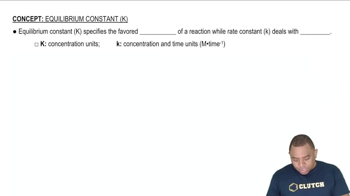
Equilibrium Constant (K)

The equilibrium constant, K, is a dimensionless value that expresses the ratio of the concentrations of products to reactants at equilibrium for a given reaction at a specific temperature. It is calculated using the formula K = [products]^[coefficients] / [reactants]^[coefficients]. A large K value indicates that products are favored at equilibrium, while a small K value suggests that reactants are favored.
추천 영상:
가이드 코스
01:14
Equilibrium Constant K

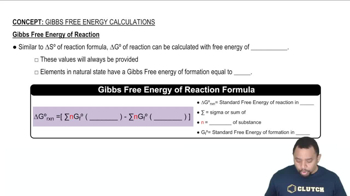
Gibbs Free Energy (ΔG°)

Gibbs free energy, ΔG°, is a thermodynamic potential that indicates the spontaneity of a reaction at constant temperature and pressure. It is related to the equilibrium constant by the equation ΔG° = -RT ln(K), where R is the universal gas constant and T is the temperature in Kelvin. A negative ΔG° value suggests that the reaction is spontaneous in the forward direction.
추천 영상:
가이드 코스
01:51
Gibbs Free Energy of Reactions

Standard Conditions

Standard conditions refer to a set of specific conditions (usually 1 atm pressure and 298 K temperature) under which thermodynamic measurements are made. These conditions are essential for calculating standard Gibbs free energy changes and equilibrium constants, ensuring consistency and comparability of data across different reactions and studies.
추천 영상:
가이드 코스
01:10
Standard Reduction Potentials