Ch.20 - Electrochemistry
Brown - Chemistry: The Central Science 14th Edition
Brown14th EditionChemistry: The Central ScienceISBN: 9780134414232당신이 사용하는 게 아니라요?교과서 변경
20장, 문제 57b,c

A cell has a standard cell potential of +0.177 V at 298 K. What is the value of the equilibrium constant for the reaction (b) if n = 2? (c) if n = 3?

검증된 단계별 안내
1
Identify the relationship between the standard cell potential (E°) and the equilibrium constant (K) using the Nernst equation at standard conditions: E° = (RT/nF) * ln(K).
Recognize that at 298 K, the Nernst equation simplifies to: E° = (0.0592 V/n) * log(K).
Substitute the given values into the simplified equation: 0.177 V = (0.0592 V/3) * log(K).
Solve for log(K) by rearranging the equation: log(K) = (0.177 V * 3) / 0.0592 V.
Calculate K by taking the antilogarithm (base 10) of the result from the previous step: K = 10^(log(K)).

비슷한 문제에 대한 검증된 영상 답변:

이 영상 해법은 위 문제에 도움이 된다고 튜터들이 추천한 것입니다.
영상 길이:
4m

주요 개념

질문에 올바르게 답하기 위해 반드시 이해해야 하는 핵심 개념들은 다음과 같습니다.

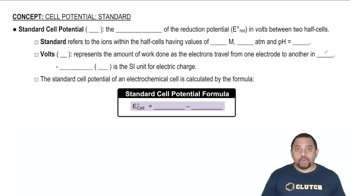
Standard Cell Potential

The standard cell potential (E°) is the measure of the voltage produced by an electrochemical cell under standard conditions (1 M concentration, 1 atm pressure, and 298 K). It indicates the tendency of a chemical reaction to occur spontaneously; a positive E° suggests a spontaneous reaction, while a negative E° indicates non-spontaneity.
추천 영상:
가이드 코스
01:27
Standard Cell Potential

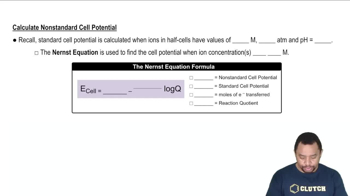
Nernst Equation

The Nernst equation relates the cell potential to the concentrations of the reactants and products at non-standard conditions. It can be used to calculate the equilibrium constant (K) for a reaction by connecting E° to the Gibbs free energy change, allowing for the determination of K when E° and the number of electrons transferred (n) are known.
추천 영상:
가이드 코스
01:17
The Nernst Equation

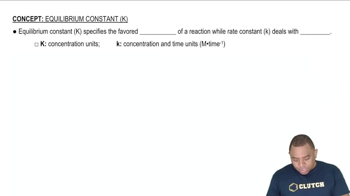
Equilibrium Constant (K)

The equilibrium constant (K) quantifies the ratio of the concentrations of products to reactants at equilibrium for a given reaction. It is a dimensionless value that reflects the extent to which a reaction proceeds; a large K indicates a reaction favoring products, while a small K suggests a preference for reactants. K can be derived from the standard cell potential using the relationship K = e^(nFE°/RT).
추천 영상:
가이드 코스
01:14
Equilibrium Constant K