Consider the following table of standard electrode potentials for a series of hypothetical reactions in an aqueous solution: reduction half-reaction E °(V) (c) Which substance(s) can oxidize C2+?
Ch.20 - Electrochemistry
20장, 문제 5
For a spontaneous reaction A1aq2 + B1aq2 → A-1aq2 + B+1aq2, answer the following questions: (a) If you made a voltaic cell out of this reaction, what half-reaction would be occurring at the cathode, and what half-reaction would be occurring at the anode?
검증된 단계별 안내1
Identify the oxidation and reduction processes in the given reaction. Oxidation involves the loss of electrons, while reduction involves the gain of electrons.
Write the half-reaction for the oxidation process. In this reaction, A1aq2 is oxidized to A-1aq2, meaning it loses electrons.
Write the half-reaction for the reduction process. In this reaction, B1aq2 is reduced to B+1aq2, meaning it gains electrons.
Determine which half-reaction occurs at the cathode. In a voltaic cell, the cathode is where reduction takes place.
Determine which half-reaction occurs at the anode. In a voltaic cell, the anode is where oxidation takes place.
주요 개념
질문에 올바르게 답하기 위해 반드시 이해해야 하는 핵심 개념들은 다음과 같습니다.
Voltaic Cell
A voltaic cell, also known as a galvanic cell, is an electrochemical cell that converts chemical energy from spontaneous redox reactions into electrical energy. It consists of two half-cells, each containing an electrode and an electrolyte. The flow of electrons from the anode to the cathode generates an electric current, making it essential to understand the roles of oxidation and reduction in this process.
추천 영상:
가이드 코스
The Electrolytic Cell
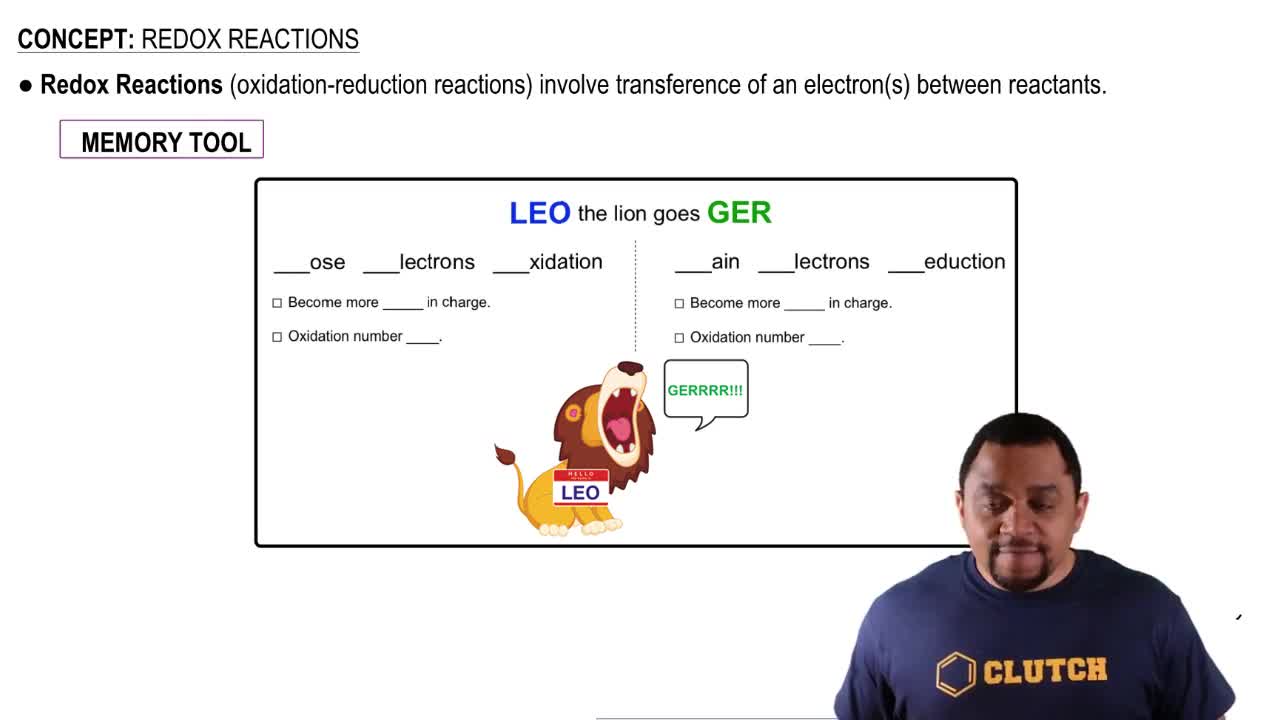
Oxidation and Reduction
Oxidation and reduction are complementary processes in redox reactions. Oxidation involves the loss of electrons, while reduction involves the gain of electrons. In a voltaic cell, the anode is where oxidation occurs (loss of electrons), and the cathode is where reduction takes place (gain of electrons). Identifying which species is oxidized and which is reduced is crucial for determining the half-reactions at each electrode.
추천 영상:
가이드 코스
Oxidation and Reduction Reactions
Half-Reactions
Half-reactions are the individual reactions that occur at the anode and cathode in an electrochemical cell. They represent the oxidation and reduction processes separately, allowing for a clearer understanding of electron transfer. In the context of the given reaction, identifying the correct half-reactions involves determining which species is oxidized and which is reduced, thus providing insight into the overall cell reaction.
추천 영상:
가이드 코스
Redox Half Reactions Example
관련 실천
교과서 질문
1173
views
교과서 질문
The diagram that follows represents a molecular view of a process occurring at an electrode in a voltaic cell.
(c) Why are the atoms in the electrode represented by larger spheres than those in the solution? [Section 20.3]
628
views
교과서 질문
Assume that you want to construct a voltaic cell that uses the following half-reactions: A2+1aq2 + 2 e- ¡ A1s2 Ered ° = -0.10 V B2+1aq2 + 2 e- ¡ B1s2 E°red = -1.10 V You begin with the incomplete cell pictured here in which the electrodes are immersed in water.
(a) What additions must you make to the cell for it to generate a standard emf?
660
views
교과서 질문
Consider the following voltaic cell:
(c) What is the change in the cell voltage when the ion concentrations in the cathode half-cell are increased by a factor of 10?
757
views