Ch.21 - Nuclear Chemistry
Brown - Chemistry: The Central Science 14th Edition
Brown14th EditionChemistry: The Central ScienceISBN: 9780134414232당신이 사용하는 게 아니라요?교과서 변경
21장, 문제 19c,d

Predict the type of radioactive decay process for the following radionuclides: (c) phosphorus-32. (d) chlorine-39.

검증된 단계별 안내
1
Identify the atomic number and mass number for each radionuclide. Phosphorus-32 has an atomic number of 15 and a mass number of 32. Chlorine-39 has an atomic number of 17 and a mass number of 39.
Determine the neutron-to-proton (n/p) ratio for each radionuclide. For phosphorus-32, calculate the number of neutrons as 32 - 15 = 17, giving an n/p ratio of 17/15. For chlorine-39, calculate the number of neutrons as 39 - 17 = 22, giving an n/p ratio of 22/17.
Compare the n/p ratio to the stable n/p ratio for elements with similar atomic numbers. Elements with atomic numbers around 15-17 typically have stable n/p ratios close to 1:1.
For phosphorus-32, the n/p ratio is slightly greater than 1, suggesting beta decay (β⁻ decay) as the likely process, where a neutron is converted into a proton, emitting a beta particle (electron) and an antineutrino.
For chlorine-39, the n/p ratio is also greater than 1, indicating that beta decay (β⁻ decay) is the probable decay process, similar to phosphorus-32, where a neutron is converted into a proton, emitting a beta particle and an antineutrino.

비슷한 문제에 대한 검증된 영상 답변:

이 영상 해법은 위 문제에 도움이 된다고 튜터들이 추천한 것입니다.
영상 길이:
1m
도움이 되었나요?

주요 개념

질문에 올바르게 답하기 위해 반드시 이해해야 하는 핵심 개념들은 다음과 같습니다.

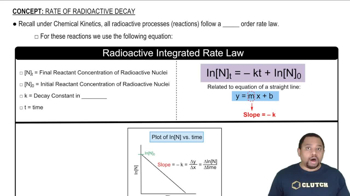
Radioactive Decay

Radioactive decay is the process by which an unstable atomic nucleus loses energy by emitting radiation. This can occur in various forms, including alpha decay, beta decay, and gamma decay, each involving the release of different particles or electromagnetic radiation. Understanding the type of decay is crucial for predicting the behavior of radionuclides over time.
추천 영상:
가이드 코스
03:00
Rate of Radioactive Decay

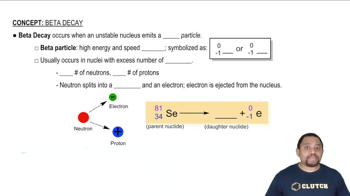
Beta Decay

Beta decay is a specific type of radioactive decay where a neutron in the nucleus is transformed into a proton, emitting a beta particle (an electron or positron) and an antineutrino or neutrino. This process increases the atomic number of the element by one, resulting in the formation of a new element. It is common in isotopes that have an excess of neutrons.
추천 영상:

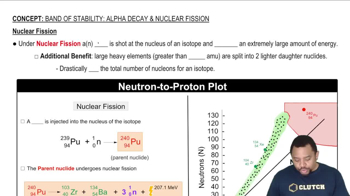
Nuclear Stability and Isotopes

Nuclear stability refers to the balance of forces within an atomic nucleus, which determines whether an isotope is stable or radioactive. Isotopes are variants of elements that have the same number of protons but different numbers of neutrons. The stability of an isotope influences its decay process; for example, phosphorus-32 and chlorine-39 have specific decay pathways based on their neutron-to-proton ratios.
추천 영상:
가이드 코스
03:29
Band of Stability: Nuclear Fission