Ch.21 - Nuclear Chemistry
Brown - Chemistry: The Central Science 14th Edition
Brown14th EditionChemistry: The Central ScienceISBN: 9780134414232당신이 사용하는 게 아니라요?교과서 변경
21장, 문제 19b

Predict the type of radioactive decay process for the following radionuclides: (b) 6829Cu.

검증된 단계별 안내
1
Step 1: Understand the concept of radioactive decay. Radioactive decay is a process by which an unstable atomic nucleus loses energy by radiation. There are three common types of radioactive decay: alpha decay, beta decay, and gamma decay.
Step 2: Identify the type of radioactive decay. The type of decay can be predicted by looking at the neutron-to-proton ratio. If the ratio is too high, the nucleus will undergo beta decay to decrease the number of neutrons. If the ratio is too low, the nucleus will undergo positron decay or electron capture to increase the number of neutrons.
Step 3: Look at the atomic number and mass number of the given radionuclide. For 6829Cu, the atomic number is 29 and the mass number is 68.
Step 4: Calculate the neutron-to-proton ratio. The number of neutrons is the mass number minus the atomic number. So, for 6829Cu, the number of neutrons is 68 - 29 = 39. The neutron-to-proton ratio is 39/29.
Step 5: Compare the neutron-to-proton ratio with the stable range. For lighter elements (atomic number less than 20), the stable neutron-to-proton ratio is about 1. For heavier elements, the ratio is slightly greater than 1. Since the neutron-to-proton ratio for 6829Cu is greater than 1, it is likely to undergo beta decay to decrease the number of neutrons.

비슷한 문제에 대한 검증된 영상 답변:

이 영상 해법은 위 문제에 도움이 된다고 튜터들이 추천한 것입니다.
영상 길이:
1m
도움이 되었나요?

주요 개념

질문에 올바르게 답하기 위해 반드시 이해해야 하는 핵심 개념들은 다음과 같습니다.

Radioactive Decay

Radioactive decay is the process by which an unstable atomic nucleus loses energy by emitting radiation. This can occur in various forms, including alpha decay, beta decay, and gamma decay, each characterized by the type of particle or energy released. Understanding the nature of the radionuclide helps predict the decay mode it will undergo.
추천 영상:
가이드 코스
03:00
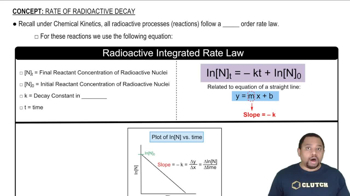
Rate of Radioactive Decay

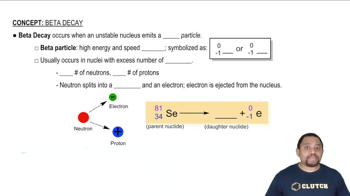
Alpha and Beta Decay

Alpha decay involves the emission of an alpha particle (two protons and two neutrons), resulting in a decrease in atomic number by two and mass number by four. Beta decay occurs when a neutron is transformed into a proton, emitting a beta particle (electron or positron), which increases the atomic number by one. The type of decay depends on the neutron-to-proton ratio in the nucleus.
추천 영상:

Stability of Nuclei

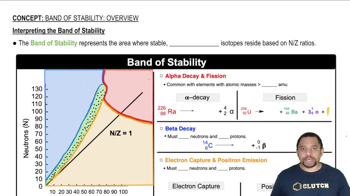
The stability of a nucleus is influenced by the balance between protons and neutrons, known as the neutron-to-proton ratio. Nuclei with too many or too few neutrons compared to protons tend to be unstable and undergo radioactive decay to achieve a more stable configuration. For copper-68, analyzing its neutron-to-proton ratio helps determine its decay process.
추천 영상:
가이드 코스
03:13
Intepreting the Band of Stability