
Ch.22 - Chemistry of the Nonmetals
Brown - Chemistry: The Central Science 14th Edition
Brown14th EditionChemistry: The Central ScienceISBN: 9780134414232당신이 사용하는 게 아니라요?교과서 변경
22장, 문제 13

Complete the exercises below. Consider the elements O, Ba, Co, Be, Br, and Se. From this list, select the element that: a. is most electronegative, b. exhibits a maximum oxidation state of +7, c. loses an electron most readily, d. forms π bonds most readily, e. is a transition metal, f. is a liquid at room temperature and pressure.

검증된 단계별 안내
1
Step 1: Identify the most electronegative element. Electronegativity is the tendency of an atom to attract electrons. In the periodic table, electronegativity increases across a period and decreases down a group. Compare the elements O, Ba, Co, Be, Br, and Se to determine which is most electronegative.
Step 2: Determine which element exhibits a maximum oxidation state of +7. Oxidation states are related to the number of electrons an atom can lose, gain, or share. Consider the common oxidation states of the elements listed to find the one that can reach +7.
Step 3: Identify the element that loses an electron most readily. This is related to ionization energy, which is the energy required to remove an electron from an atom. Elements with low ionization energy lose electrons more easily. Compare the ionization energies of the elements provided.
Step 4: Determine which element forms π bonds most readily. π bonds are formed by the sideways overlap of p orbitals. Elements with multiple p orbitals and the ability to form double or triple bonds are more likely to form π bonds. Consider the electronic configuration and bonding tendencies of the elements.
Step 5: Identify the element that is a transition metal. Transition metals are found in the d-block of the periodic table and are characterized by their ability to form variable oxidation states and colored compounds. Determine which element from the list fits this description.

주요 개념

질문에 올바르게 답하기 위해 반드시 이해해야 하는 핵심 개념들은 다음과 같습니다.

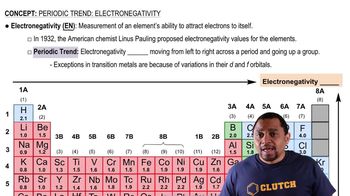
Electronegativity

Electronegativity is a measure of an atom's ability to attract and hold onto electrons in a chemical bond. It is a key factor in determining how atoms interact with each other, influencing bond polarity and the nature of chemical reactions. The most electronegative element is fluorine, but among the given elements, oxygen is the most electronegative, which affects its reactivity and bonding behavior.
추천 영상:
가이드 코스
02:10
Electronegativity Trends

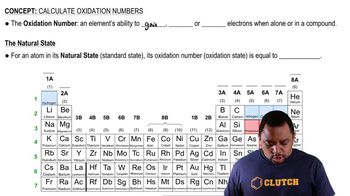
Oxidation States

Oxidation states indicate the degree of oxidation of an atom in a compound, reflecting the number of electrons lost or gained. Elements can exhibit various oxidation states, with some capable of reaching high positive values. For example, elements like bromine can have a maximum oxidation state of +7, which is important for understanding their chemical reactivity and the types of compounds they can form.
추천 영상:
가이드 코스
02:42
Oxidation Numbers

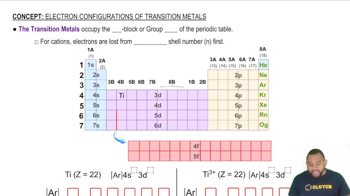
Transition Metals

Transition metals are elements found in the d-block of the periodic table, characterized by their ability to form variable oxidation states and complex ions. They are known for their ability to conduct electricity and heat, as well as their catalytic properties. Cobalt (Co) is an example of a transition metal, and understanding its properties is essential for predicting its behavior in chemical reactions.
추천 영상:
가이드 코스
03:12
Transition Metals