
Ch.22 - Chemistry of the Nonmetals
Brown - Chemistry: The Central Science 14th Edition
Brown14th EditionChemistry: The Central ScienceISBN: 9780134414232당신이 사용하는 게 아니라요?교과서 변경
22장, 문제 12

Complete the exercises below. Identify each of the following elements as a metal, nonmetal, or metalloid: a. gallium, b. molybdenum, c. tellurium, d. arsenic, e. xenon, f. ruthenium.

검증된 단계별 안내
1
Step 1: Understand the classification of elements into metals, nonmetals, and metalloids based on their properties. Metals are typically shiny, good conductors of heat and electricity, and malleable. Nonmetals are poor conductors and can be gases, liquids, or brittle solids. Metalloids have properties intermediate between metals and nonmetals.
Step 2: Locate each element on the periodic table to determine its classification. The position of an element on the periodic table can help identify whether it is a metal, nonmetal, or metalloid.
Step 3: Identify gallium (Ga). Gallium is located in group 13 of the periodic table, which is typically associated with metals. It is a metal.
Step 4: Identify molybdenum (Mo). Molybdenum is found in group 6, which is part of the transition metals section. It is a metal.
Step 5: Identify tellurium (Te). Tellurium is located in group 16 and is considered a metalloid due to its intermediate properties between metals and nonmetals.

주요 개념

질문에 올바르게 답하기 위해 반드시 이해해야 하는 핵심 개념들은 다음과 같습니다.

Periodic Table Classification

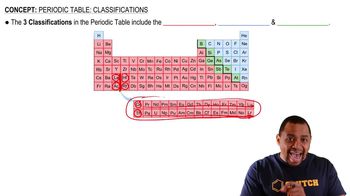
Elements are classified into metals, nonmetals, and metalloids based on their properties and positions in the periodic table. Metals, typically found on the left side, are good conductors of heat and electricity, while nonmetals, located on the right, are poor conductors and often have more varied properties. Metalloids, situated along the zig-zag line, exhibit characteristics of both metals and nonmetals.
추천 영상:
가이드 코스
02:40
Periodic Table Classifications

Properties of Metals

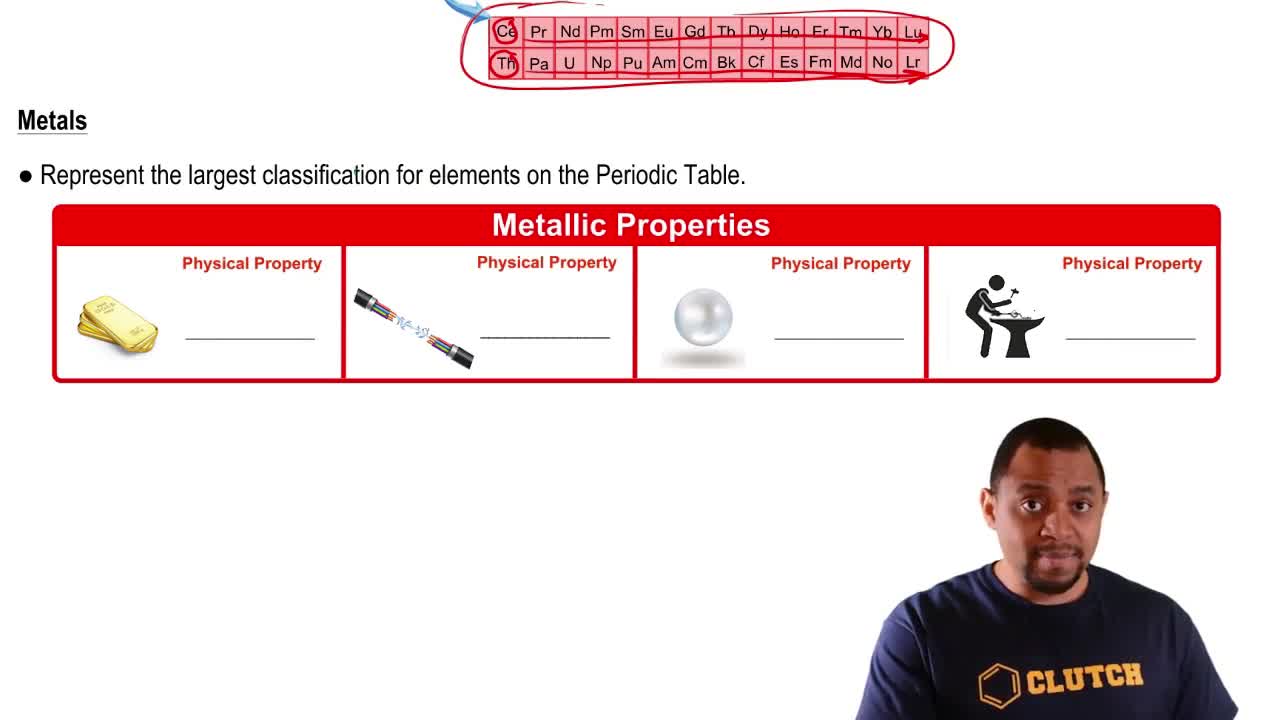
Metals are generally characterized by their luster, malleability, ductility, and high electrical and thermal conductivity. They tend to lose electrons during chemical reactions, forming positive ions. Common examples include elements like iron, copper, and aluminum, which are widely used in various applications due to their favorable physical properties.
추천 영상:
가이드 코스
02:05
Metal Properties

Properties of Nonmetals

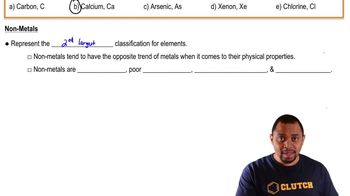
Nonmetals are elements that typically lack the characteristics of metals. They are usually poor conductors of heat and electricity, and many are gases at room temperature. Nonmetals can gain electrons in chemical reactions, forming negative ions. Examples include oxygen, nitrogen, and noble gases like xenon, which have distinct roles in chemical processes.
추천 영상:
가이드 코스
01:12
Nonmetal Properties