

Ch.4 - Reactions in Aqueous Solution
Brown - Chemistry: The Central Science 14th Edition
Brown14th EditionChemistry: The Central ScienceISBN: 9780134414232당신이 사용하는 게 아니라요?교과서 변경
4장, 문제 13a

State whether each of the following statements is true or false. Justify your answer in each case. (a) Electrolyte solutions conduct electricity because electrons are moving through the solution.

검증된 단계별 안내
1
Understand the concept of electrolytes: Electrolytes are substances that dissolve in water to produce a solution that conducts electricity. They dissociate into ions, which are charged particles.
Identify the role of ions in conducting electricity: In an electrolyte solution, it is the movement of ions, not electrons, that allows the solution to conduct electricity.
Clarify the misconception: Electrons do not move through the solution. Instead, the ions (cations and anions) move towards the electrodes, allowing the flow of electric current.
Consider the nature of electric current in solutions: Electric current in solutions is carried by the movement of ions, which are attracted to the oppositely charged electrodes.
Conclude the statement's validity: Based on the understanding that ions, not electrons, are responsible for conducting electricity in electrolyte solutions, determine whether the statement is true or false.

비슷한 문제에 대한 검증된 영상 답변:

이 영상 해법은 위 문제에 도움이 된다고 튜터들이 추천한 것입니다.
영상 길이:
4m
도움이 되었나요?

주요 개념

질문에 올바르게 답하기 위해 반드시 이해해야 하는 핵심 개념들은 다음과 같습니다.

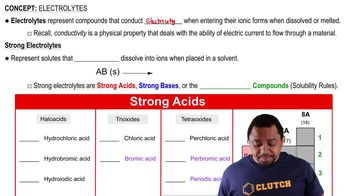
Electrolytes

Electrolytes are substances that dissociate into ions when dissolved in water, allowing the solution to conduct electricity. Common examples include salts, acids, and bases. The presence of free-moving ions in the solution is crucial for electrical conductivity, as these charged particles can carry electric current.
추천 영상:
가이드 코스
02:50
Electrolytes and Strong Acids

Electrical Conductivity

Electrical conductivity in solutions is primarily due to the movement of ions rather than electrons. When an electric field is applied, positive ions move towards the negative electrode and negative ions move towards the positive electrode, facilitating the flow of electric current. This is a key distinction from solid conductors, where electrons are the primary charge carriers.
추천 영상:
가이드 코스
01:40
Extensive Property Example

Ionic vs. Electronic Conduction

In electrolytic solutions, conduction occurs through the movement of ions, while in metals, conduction is due to the flow of electrons. This difference is fundamental in understanding how various materials conduct electricity. In the context of the question, the statement is false because it incorrectly attributes electrical conduction in electrolyte solutions to electron movement.
추천 영상: