
Ch.4 - Reactions in Aqueous Solution
Brown - Chemistry: The Central Science 14th Edition
Brown14th EditionChemistry: The Central ScienceISBN: 9780134414232당신이 사용하는 게 아니라요?교과서 변경
4장, 문제 12

You are titrating an acidic solution with a basic one, and just realized you forgot to add the indicator that tells you when the equivalence point is reached. In this titration, the indicator turns blue at the equivalence point from an initially colorless solution. You quickly grab a bottle of indicator and add some to your titration beaker, and the whole solution turns dark blue. What do you do now?

검증된 단계별 안내
1
1. The dark blue color indicates that the solution has passed the equivalence point. This is because the indicator changes color when the solution changes from acidic to basic, which happens at the equivalence point. If the solution is dark blue, it means it is now basic.
2. The titration has gone too far, and you've added more base than needed to neutralize the acid. Therefore, you cannot accurately determine the concentration of the acid in the solution at this point.
3. To correct this, you will need to start the titration process over again. Dispose of the current solution safely according to your lab's guidelines.
4. Prepare a new sample of the acidic solution, ensuring it is the same volume and concentration as the original sample.
5. Before starting the titration, remember to add the indicator to the new solution. Then, proceed with the titration, adding the base slowly and carefully to avoid overshooting the equivalence point again.

비슷한 문제에 대한 검증된 영상 답변:

이 영상 해법은 위 문제에 도움이 된다고 튜터들이 추천한 것입니다.
영상 길이:
1m
도움이 되었나요?

주요 개념

질문에 올바르게 답하기 위해 반드시 이해해야 하는 핵심 개념들은 다음과 같습니다.

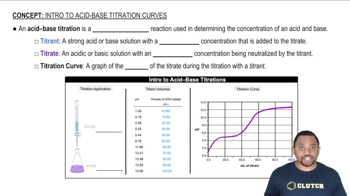
Titration

Titration is a quantitative analytical technique used to determine the concentration of an unknown solution by reacting it with a solution of known concentration. In an acid-base titration, an acid reacts with a base, and the endpoint is indicated by a color change, often facilitated by an indicator. Understanding the titration process is crucial for interpreting results and determining the equivalence point.
추천 영상:
가이드 코스
03:04
Acid-Base Titration

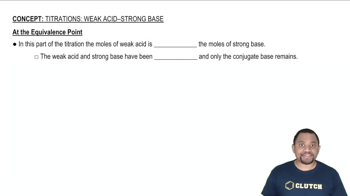
Equivalence Point

The equivalence point in a titration is the stage at which the amount of titrant added is stoichiometrically equivalent to the amount of substance in the solution being titrated. This point is significant because it indicates that the reaction between the acid and base is complete. Identifying the equivalence point is essential for accurate calculations of concentration.
추천 영상:
가이드 코스
01:07
At the Equivalence Point

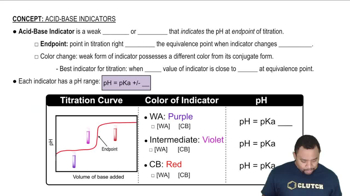
Indicators

Indicators are substances that change color at a specific pH range, signaling the completion of a reaction in titrations. In this scenario, the indicator turns blue at the equivalence point, providing a visual cue for the titration's progress. Choosing the appropriate indicator is vital, as it must change color at or near the pH of the equivalence point for accurate results.
추천 영상:
가이드 코스
04:30
Acid-Base Indicators