Ch.5 - Thermochemistry
Brown - Chemistry: The Central Science 14th Edition
Brown14th EditionChemistry: The Central ScienceISBN: 9780134414232당신이 사용하는 게 아니라요?교과서 변경
5장, 문제 46c

At one time, a common means of forming small quantities of oxygen gas in the laboratory was to heat KClO3: 2 KClO3(s) → 2 KCl(s) + 3 O2(g) ΔH = -89.4 kJ (c) The decomposition of KClO3 proceeds spontaneously when it is heated. Do you think that the reverse reaction, the formation of KClO3 from KCl and O2, is likely to be feasible under ordinary conditions? Explain your answer.

검증된 단계별 안내
1
Identify the reaction type: The given reaction is a decomposition reaction where potassium chlorate (KClO3) breaks down into potassium chloride (KCl) and oxygen gas (O2) upon heating.
Analyze the reaction's enthalpy change (ΔH): The reaction has a negative ΔH value of -89.4 kJ, indicating that it is exothermic. This means that energy is released when KClO3 decomposes.
Consider the reverse reaction: The reverse reaction would be the synthesis of KClO3 from KCl and O2. Since the forward reaction is exothermic, the reverse reaction would be endothermic, requiring an input of energy (89.4 kJ).
Evaluate the feasibility under ordinary conditions: Endothermic reactions, such as the reverse reaction here, are generally not spontaneous at room temperature without an external source of energy.
Conclude based on spontaneity: Given that the reverse reaction is endothermic and would require continuous energy input to proceed, it is unlikely to be feasible under ordinary conditions without specific, controlled circumstances.

비슷한 문제에 대한 검증된 영상 답변:

이 영상 해법은 위 문제에 도움이 된다고 튜터들이 추천한 것입니다.
영상 길이:
3m

주요 개념

질문에 올바르게 답하기 위해 반드시 이해해야 하는 핵심 개념들은 다음과 같습니다.

Thermodynamics and Enthalpy

Thermodynamics is the study of energy transformations, and enthalpy (ΔH) is a key concept that measures the heat content of a system. In the given reaction, the negative ΔH indicates that the decomposition of KClO3 is exothermic, releasing energy. This suggests that the reverse reaction, which is endothermic, would require an input of energy to proceed, making it less favorable under ordinary conditions.
추천 영상:
가이드 코스
02:34
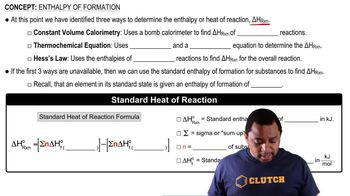
Enthalpy of Formation

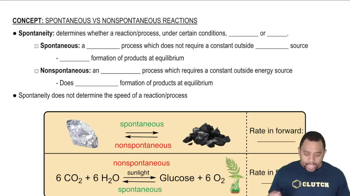
Spontaneity of Reactions

A reaction's spontaneity is determined by its Gibbs free energy change (ΔG), which considers both enthalpy and entropy. The decomposition of KClO3 is spontaneous at elevated temperatures, indicating that the products are favored. Conversely, the formation of KClO3 from KCl and O2 would likely have a positive ΔG under normal conditions, suggesting that it is not spontaneous and thus less feasible.
추천 영상:
가이드 코스
04:20
Spontaneity of Processes

Reaction Conditions and Kinetics

The feasibility of a chemical reaction also depends on the conditions under which it occurs, including temperature, pressure, and concentration. The reverse reaction of forming KClO3 from KCl and O2 may require specific conditions, such as high temperatures or catalysts, to overcome the activation energy barrier. Without these conditions, the reaction is unlikely to proceed efficiently in a typical laboratory setting.
추천 영상:
가이드 코스
02:13
Ideal Gas Conditions Example
관련 실천
교과서 질문

Consider the combustion of liquid methanol, CH3OH(l): CH3OH(l) + 3/2 O2(g) → CO2(g) + 2 H2O(l) ΔH = -726.5 kJ (b) Balance the forward reaction with whole-number coefficients. What is ΔH for the reaction represented by this equation?

706
views

교과서 질문

When solutions containing silver ions and chloride ions are mixed, silver chloride precipitates Ag+(aq) + Cl-(aq) → AgCl(s) H = -65.5 kJ (a) Calculate H for the production of 0.450 mol of AgCl by this reaction. (b) Calculate H for the production of 9.00 g of AgCl. (c) Calculate H when 9.25⨉10-4 mol of AgCl dissolves in water.

861
views
교과서 질문

At one time, a common means of forming small quantities of oxygen gas in the laboratory was to heat KClO3: 2 KClO3(s) → 2 KCl(s) + 3 O2(g) ΔH = -89.4 kJ For this reaction, calculate H for the formation of (a) 1.36 mol of O2

560
views
교과서 질문

At one time, a common means of forming small quantities of oxygen gas in the laboratory was to heat KClO3: 2 KClO3(s) → 2 KCl(s) + 3 O2(g) ΔH = -89.4 kJ For this reaction, calculate H for the formation of (b) 10.4 g of KCl.

423
views
교과서 질문

Consider the combustion of liquid methanol, CH3OH(l): CH3OH(l) + 3/2 O2(g) → CO2(g) + 2 H2O(l) ΔH = -726.5 kJ (d) If the reaction were written to produce H2O(g) instead of H2O(l), would you expect the magnitude of ΔH to increase, decrease, or stay the same? Explain.

1
views
교과서 질문

Consider the combustion of liquid methanol, CH3OH(l): CH3OH(l) + 3/2 O2(g) → CO2(g) + 2 H2O(l) ΔH = -726.5 kJ (a) What is the enthalpy change for the reverse reaction?

744
views