
Ch.5 - Thermochemistry
Brown - Chemistry: The Central Science 14th Edition
Brown14th EditionChemistry: The Central ScienceISBN: 9780134414232당신이 사용하는 게 아니라요?교과서 변경
5장, 문제 45

When solutions containing silver ions and chloride ions are mixed, silver chloride precipitates Ag+(aq) + Cl-(aq) → AgCl(s) H = -65.5 kJ (a) Calculate H for the production of 0.450 mol of AgCl by this reaction. (b) Calculate H for the production of 9.00 g of AgCl. (c) Calculate H when 9.25⨉10-4 mol of AgCl dissolves in water.

검증된 단계별 안내
1
Identify the given enthalpy change (H) for the formation of 1 mole of AgCl, which is -65.5 kJ/mol.
For part (a), use the stoichiometry of the reaction to calculate the total enthalpy change for the formation of 0.450 mol of AgCl. Multiply the moles of AgCl by the enthalpy change per mole.
For part (b), first convert the mass of AgCl (9.00 g) to moles using the molar mass of AgCl (Ag: 107.87 g/mol, Cl: 35.45 g/mol). Then, calculate the enthalpy change by multiplying the moles of AgCl by the enthalpy change per mole.
For part (c), since the reaction of AgCl dissolving is the reverse of the precipitation, the sign of the enthalpy change will be opposite. Calculate the enthalpy change for the dissolution of 9.25⨉10^-4 mol of AgCl by multiplying the moles by the negative of the enthalpy change per mole.
Ensure all calculations consider the correct sign of the enthalpy change, as it indicates whether the reaction is exothermic (-) or endothermic (+).

비슷한 문제에 대한 검증된 영상 답변:

이 영상 해법은 위 문제에 도움이 된다고 튜터들이 추천한 것입니다.
영상 길이:
1m
도움이 되었나요?

주요 개념

질문에 올바르게 답하기 위해 반드시 이해해야 하는 핵심 개념들은 다음과 같습니다.

Stoichiometry

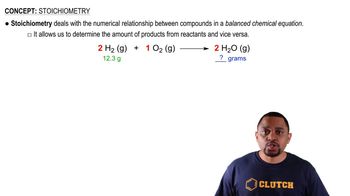
Stoichiometry is the calculation of reactants and products in chemical reactions based on the balanced chemical equation. It allows us to determine the amount of substance produced or consumed in a reaction, using mole ratios derived from the coefficients in the balanced equation. In this case, understanding the stoichiometry of the reaction between silver ions and chloride ions is essential for calculating the enthalpy change (ΔH) for different amounts of silver chloride (AgCl).
추천 영상:
가이드 코스
01:16
Stoichiometry Concept

Enthalpy Change (ΔH)

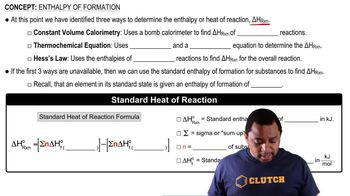
Enthalpy change (ΔH) is a measure of the heat absorbed or released during a chemical reaction at constant pressure. It indicates whether a reaction is exothermic (releases heat, ΔH < 0) or endothermic (absorbs heat, ΔH > 0). In the given reaction, the negative ΔH value of -65.5 kJ signifies that the formation of AgCl from its ions is exothermic, which is crucial for calculating the heat change for different quantities of AgCl produced or dissolved.
추천 영상:
가이드 코스
02:34
Enthalpy of Formation

Molar Mass

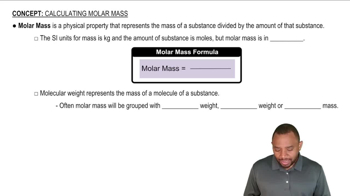
Molar mass is the mass of one mole of a substance, typically expressed in grams per mole (g/mol). It is essential for converting between the mass of a substance and the number of moles, which is necessary for stoichiometric calculations. For example, to calculate the enthalpy change for the production of 9.00 g of AgCl, one must first determine the molar mass of AgCl to convert grams to moles, enabling the application of the stoichiometric relationships and ΔH.
추천 영상:
가이드 코스
02:11
Molar Mass Concept
관련 실천
교과서 질문

At one time, a common means of forming small quantities of oxygen gas in the laboratory was to heat KClO3: 2 KClO3(s) → 2 KCl(s) + 3 O2(g) ΔH = -89.4 kJ (c) The decomposition of KClO3 proceeds spontaneously when it is heated. Do you think that the reverse reaction, the formation of KClO3 from KCl and O2, is likely to be feasible under ordinary conditions? Explain your answer.

559
views
교과서 질문

At one time, a common means of forming small quantities of oxygen gas in the laboratory was to heat KClO3: 2 KClO3(s) → 2 KCl(s) + 3 O2(g) ΔH = -89.4 kJ For this reaction, calculate H for the formation of (a) 1.36 mol of O2

560
views
교과서 질문

At one time, a common means of forming small quantities of oxygen gas in the laboratory was to heat KClO3: 2 KClO3(s) → 2 KCl(s) + 3 O2(g) ΔH = -89.4 kJ For this reaction, calculate H for the formation of (b) 10.4 g of KCl.

423
views
교과서 질문

Consider the following reaction: 2 CH3OH(g) → 2 CH4(g) + O2(g) ΔH = +252.8 kJ (d) How many kilojoules of heat are released when 38.5 g of CH4(g) reacts completely with O2(g) to form CH3OH(g) at constant pressure?

458
views
교과서 질문

Consider the following reaction: 2 CH3OH(g) → 2 CH4(g) + O2(g) ΔH = +252.8 kJ (c) For a given sample of CH3OH, the enthalpy change during the reaction is 82.1 kJ. How many grams of methane gas are produced?

교과서 질문

Consider the following reaction: 2 CH3OH(g) → 2 CH4(g) + O2(g) ΔH = +252.8 kJ (b) Calculate the amount of heat transferred when 24.0 g of CH3OH(g) is decomposed by this reaction at constant pressure.

719
views
1
rank