Ch.5 - Thermochemistry
Brown - Chemistry: The Central Science 14th Edition
Brown14th EditionChemistry: The Central ScienceISBN: 9780134414232당신이 사용하는 게 아니라요?교과서 변경
5장, 문제 48c

Consider the decomposition of liquid benzene, C6H6(l), to gaseous acetylene, C2H2(g): C6H6(l) → 3 C2H2(g) ΔH = +630 kJ (c) Which is more likely to be thermodynamically favored, the forward reaction or the reverse reaction?

검증된 단계별 안내
1
Identify the sign of the enthalpy change (ΔH) for the reaction. A positive ΔH indicates that the reaction is endothermic, meaning it absorbs heat from the surroundings.
Understand that thermodynamically favored reactions are generally those that release energy (exothermic reactions), where ΔH is negative, as they lead to a decrease in the system's enthalpy, making the products more stable than the reactants.
Compare the enthalpy change of the forward reaction, which is +630 kJ, indicating that it is endothermic and requires energy input to proceed.
Consider the reverse reaction, where the sign of ΔH would be negative (-630 kJ), suggesting that it is exothermic. This reaction would release energy, making it more likely to occur spontaneously under standard conditions.
Conclude that the reverse reaction, forming liquid benzene from gaseous acetylene, is more likely to be thermodynamically favored due to its exothermic nature.

비슷한 문제에 대한 검증된 영상 답변:

이 영상 해법은 위 문제에 도움이 된다고 튜터들이 추천한 것입니다.
영상 길이:
2m

주요 개념

질문에 올바르게 답하기 위해 반드시 이해해야 하는 핵심 개념들은 다음과 같습니다.

Thermodynamics and Reaction Favorability

Thermodynamics is the study of energy transformations, particularly how energy changes influence the direction of chemical reactions. A reaction is thermodynamically favored if it leads to a decrease in free energy, typically indicated by a negative change in Gibbs free energy (ΔG). In this context, the forward reaction's positive enthalpy change (ΔH = +630 kJ) suggests it absorbs heat, which may affect its favorability.
추천 영상:
가이드 코스
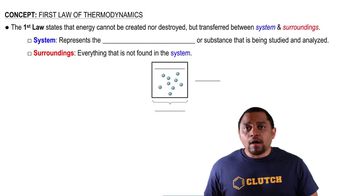
01:18
First Law of Thermodynamics

Enthalpy and Reaction Energy

Enthalpy (H) is a measure of the total energy of a thermodynamic system, including internal energy and the energy required to make room for it by displacing its environment. A positive ΔH indicates that the reaction is endothermic, meaning it requires energy input. Understanding the enthalpy change helps predict whether a reaction will proceed spontaneously under given conditions.
추천 영상:
가이드 코스
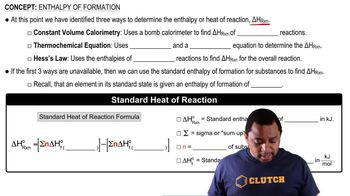
02:34
Enthalpy of Formation

Entropy and Disorder

Entropy (S) is a measure of the disorder or randomness in a system. In chemical reactions, an increase in the number of gas molecules typically leads to an increase in entropy, which can favor the reaction despite a positive enthalpy change. In this case, the decomposition of liquid benzene into gaseous acetylene increases the number of gas molecules, potentially making the forward reaction more favorable from an entropy perspective.
추천 영상:
가이드 코스
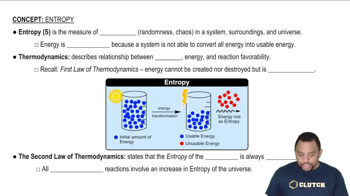
02:46
Entropy in Thermodynamics