Ch.5 - Thermochemistry
Brown - Chemistry: The Central Science 14th Edition
Brown14th EditionChemistry: The Central ScienceISBN: 9780134414232당신이 사용하는 게 아니라요?교과서 변경
5장, 문제 48d

Consider the decomposition of liquid benzene, C6H6(l), to gaseous acetylene, C2H2(g): C6H6(l) → 3 C2H2(g) ΔH = +630 kJ (d) If C6H6(g) were consumed instead of C6H6(l), would you expect the magnitude of ΔH to increase, decrease, or stay the same? Explain.

검증된 단계별 안내
1
Identify the phase change involved in the reaction. In the original reaction, benzene is in the liquid phase (C6H6(l)). If it were in the gaseous phase (C6H6(g)), this introduces a phase change from liquid to gas.
Recall that converting a substance from liquid to gas requires energy, known as the heat of vaporization. This energy is absorbed by the substance to overcome intermolecular forces.
Understand that the heat of reaction (ΔH) for a process includes all energy changes, including phase changes. If benzene starts as a gas instead of a liquid, the energy required for vaporization is not needed in the reaction pathway.
Consider how the absence of the heat of vaporization in the reaction pathway would affect the overall ΔH. Since the vaporization step (which absorbs energy) is omitted, the total energy change for the reaction would be less positive.
Conclude that if C6H6(g) were consumed instead of C6H6(l), the magnitude of ΔH would decrease because the reaction would not need to absorb the additional energy required for vaporizing liquid benzene.

비슷한 문제에 대한 검증된 영상 답변:

이 영상 해법은 위 문제에 도움이 된다고 튜터들이 추천한 것입니다.
영상 길이:
2m

주요 개념

질문에 올바르게 답하기 위해 반드시 이해해야 하는 핵심 개념들은 다음과 같습니다.

Enthalpy Change (ΔH)

Enthalpy change (ΔH) is a measure of the heat content of a system at constant pressure. It indicates whether a reaction is exothermic (releases heat, ΔH < 0) or endothermic (absorbs heat, ΔH > 0). In this case, the positive ΔH of +630 kJ signifies that the decomposition of liquid benzene into gaseous acetylene is an endothermic process, requiring energy input.
추천 영상:
가이드 코스
02:34
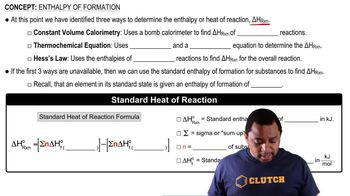
Enthalpy of Formation

Phase Changes and Energy

The phase of a substance significantly affects its energy content. Transitioning from a liquid to a gas requires energy to overcome intermolecular forces, which is reflected in the enthalpy change. If benzene is in the gaseous state, it has already absorbed energy to vaporize, potentially altering the overall energy dynamics of the reaction compared to starting with liquid benzene.
추천 영상:
가이드 코스
01:46
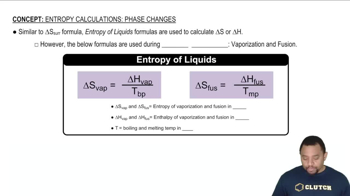
Entropy in Phase Changes

Reaction Pathway and Thermodynamics

The thermodynamic properties of a reaction can vary based on the initial and final states of the reactants. The pathway taken during a reaction, including the states of matter involved, can influence the total energy change. If gaseous benzene is consumed instead of liquid, the energy required for the reaction may differ, potentially leading to a different ΔH value, depending on the energy already present in the gaseous state.
추천 영상:
가이드 코스
01:18
First Law of Thermodynamics