Ch.7 - Periodic Properties of the Elements
Brown - Chemistry: The Central Science 14th Edition
Brown14th EditionChemistry: The Central ScienceISBN: 9780134414232당신이 사용하는 게 아니라요?교과서 변경
7장, 문제 63b

Chlorine reacts with oxygen to form Cl2O7. (b) Write a balanced equation for the formation of Cl2O71l2 from the elements.

검증된 단계별 안내
1
Step 1: Identify the reactants and the product. In this case, the reactants are Chlorine (Cl2) and Oxygen (O2), and the product is Cl2O7.
Step 2: Write the unbalanced chemical equation. This is done by writing the reactants on the left side of the equation and the product on the right side of the equation. The unbalanced equation would be: Cl2 + O2 -> Cl2O7.
Step 3: Balance the equation. Start by balancing the Chlorine atoms. In this case, there are 2 Chlorine atoms on both sides of the equation, so they are already balanced.
Step 4: Next, balance the Oxygen atoms. There are 2 Oxygen atoms on the left side of the equation and 7 on the right side. To balance the Oxygen atoms, you can place a coefficient of 7/2 in front of the O2 on the left side of the equation. This gives: Cl2 + 7/2 O2 -> Cl2O7.
Step 5: However, in chemistry, we generally avoid using fractional coefficients. To get rid of the fraction, multiply every coefficient by 2. This gives the final balanced equation: 2 Cl2 + 7 O2 -> 2 Cl2O7.

비슷한 문제에 대한 검증된 영상 답변:

이 영상 해법은 위 문제에 도움이 된다고 튜터들이 추천한 것입니다.
영상 길이:
1m
도움이 되었나요?

주요 개념

질문에 올바르게 답하기 위해 반드시 이해해야 하는 핵심 개념들은 다음과 같습니다.

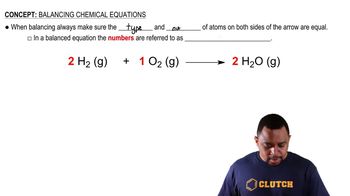
Balancing Chemical Equations

Balancing chemical equations is essential to ensure that the number of atoms of each element is the same on both sides of the equation. This reflects the law of conservation of mass, which states that matter cannot be created or destroyed in a chemical reaction. To balance an equation, coefficients are adjusted in front of the chemical formulas to achieve equal atom counts.
추천 영상:
가이드 코스
01:32
Balancing Chemical Equations

Stoichiometry

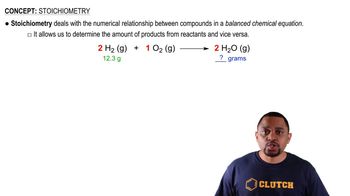
Stoichiometry involves the calculation of reactants and products in chemical reactions based on their molar ratios. It allows chemists to predict the amounts of substances consumed and produced in a reaction. Understanding stoichiometry is crucial for writing balanced equations and for practical applications in laboratory settings.
추천 영상:
가이드 코스
01:16
Stoichiometry Concept

Formation Reactions

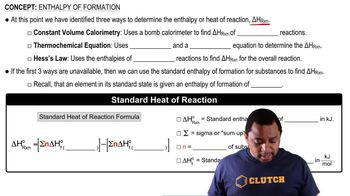
A formation reaction is a specific type of chemical reaction where elements combine to form a compound. In the context of the question, the formation of Cl2O7 from chlorine and oxygen involves identifying the correct stoichiometric coefficients for each element. This concept is fundamental in understanding how compounds are synthesized from their elemental forms.
추천 영상:
가이드 코스
02:34
Enthalpy of Formation