


Ch.8 - Basic Concepts of Chemical Bonding
Brown - Chemistry: The Central Science 14th Edition
Brown14th EditionChemistry: The Central ScienceISBN: 9780134414232당신이 사용하는 게 아니라요?교과서 변경
8장, 문제 105b

Acetylene (C2H2) and nitrogen (N2) both contain a triple bond, but they differ greatly in their chemical properties. (b) By referring to Appendix C, look up the enthalpies of formation of acetylene and nitrogen. Which compound is more stable?

검증된 단계별 안내
1
Identify the enthalpy of formation (\( \Delta H_f^\circ \)) for each compound from Appendix C.
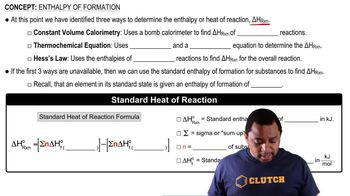
Recall that the enthalpy of formation is the change in enthalpy when one mole of a compound is formed from its elements in their standard states.
Understand that a more negative enthalpy of formation indicates a more stable compound, as it releases more energy upon formation.
Compare the \( \Delta H_f^\circ \) values of acetylene (C_2H_2) and nitrogen (N_2).
Determine which compound has a more negative \( \Delta H_f^\circ \) value to conclude which is more stable.

비슷한 문제에 대한 검증된 영상 답변:

이 영상 해법은 위 문제에 도움이 된다고 튜터들이 추천한 것입니다.
영상 길이:
2m
도움이 되었나요?

주요 개념

질문에 올바르게 답하기 위해 반드시 이해해야 하는 핵심 개념들은 다음과 같습니다.

Enthalpy of Formation

Enthalpy of formation is the change in enthalpy when one mole of a compound is formed from its elements in their standard states. It provides insight into the stability of a compound; lower enthalpy values indicate greater stability. For example, if acetylene has a higher enthalpy of formation than nitrogen, it suggests that nitrogen is more stable under standard conditions.
추천 영상:
가이드 코스
02:34
Enthalpy of Formation

Triple Bonds

A triple bond consists of one sigma bond and two pi bonds, resulting in a strong interaction between two atoms. In acetylene (C2H2), the carbon atoms are connected by a triple bond, which contributes to its reactivity and energy content. In contrast, nitrogen (N2) also has a triple bond, but its stability is enhanced by the strong bond energy, making it less reactive than acetylene.
추천 영상:
가이드 코스
00:59
Bond Order and Type of Bond

Chemical Stability

Chemical stability refers to the tendency of a compound to maintain its structure and resist change under various conditions. Factors influencing stability include bond strength, molecular structure, and enthalpy of formation. In this context, comparing the enthalpies of formation of acetylene and nitrogen helps determine which compound is more stable, with lower energy compounds being more stable.
추천 영상:
가이드 코스
03:13
Intepreting the Band of Stability