

Acetylene (C2H2) and nitrogen (N2) both contain a triple bond, but they differ greatly in their chemical properties. (b) By referring to Appendix C, look up the enthalpies of formation of acetylene and nitrogen. Which compound is more stable?
Ch.8 - Basic Concepts of Chemical Bonding
8장, 문제 102d
One scale for electronegativity is based on the concept that the electronegativity of any atom is proportional to the ionization energy of the atom minus its electron affinity: electronegativity = k1I - EA2, where k is a proportionality constant. (d) Use your result from part (c) to determine the electronegativities of Cl and O using this scale. Use your result to determine the electronegativity of Cl using this scale.
검증된 단계별 안내1
Step 1: The first step is to understand the formula given. The electronegativity of an atom is given by the formula: electronegativity = k(I - EA), where I is the ionization energy, EA is the electron affinity, and k is a proportionality constant.
Step 2: To find the electronegativity of Chlorine (Cl) and Oxygen (O), you need to know their ionization energies and electron affinities. These values can be found in a standard chemistry reference book or online.
Step 3: Once you have the ionization energy and electron affinity for each atom, substitute these values into the formula. Remember to use the same units for both values.
Step 4: The proportionality constant, k, is the same for all atoms. Therefore, you can compare the electronegativities of different atoms even if you don't know the exact value of k.
Step 5: After substituting the values into the formula, you will get the electronegativity of each atom. The atom with the higher electronegativity is more likely to attract electrons.

비슷한 문제에 대한 검증된 영상 답변:
이 영상 해법은 위 문제에 도움이 된다고 튜터들이 추천한 것입니다.
영상 길이:
4m도움이 되었나요?
주요 개념
질문에 올바르게 답하기 위해 반드시 이해해야 하는 핵심 개념들은 다음과 같습니다.
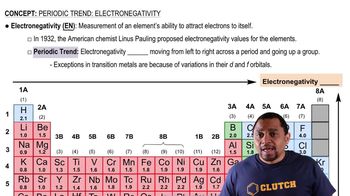
Electronegativity
Electronegativity is a measure of an atom's ability to attract and hold onto electrons when forming chemical bonds. It is a key factor in determining the nature of bonds between atoms, influencing molecular polarity and reactivity. The scale of electronegativity helps predict how electrons are distributed in a molecule, affecting its chemical properties.
추천 영상:
가이드 코스
Electronegativity Trends
Ionization Energy
Ionization energy is the energy required to remove an electron from an isolated atom in its gaseous state. It reflects how strongly an atom holds onto its electrons; higher ionization energy indicates a stronger attraction. This property is crucial for understanding electronegativity, as atoms with higher ionization energies tend to have higher electronegativities.
추천 영상:
가이드 코스
Ionization Energy
Electron Affinity
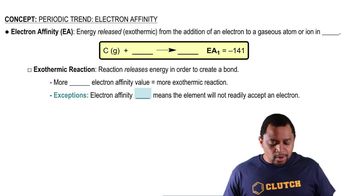
Electron affinity is the amount of energy released when an electron is added to a neutral atom in the gas phase. It indicates how much an atom wants to gain an electron. A higher electron affinity means that an atom is more likely to attract additional electrons, which plays a significant role in determining its electronegativity.
추천 영상:
가이드 코스
Electron Affinity
관련 실천
교과서 질문
344
views
교과서 질문
One scale for electronegativity is based on the concept that the electronegativity of any atom is proportional to the ionization energy of the atom minus its electron affinity: electronegativity = k1I - EA2, where k is a proportionality constant. (b) Why are both ionization energy and electron affinity relevant to the notion of electronegativity?
1070
views
교과서 질문
One scale for electronegativity is based on the concept that the electronegativity of any atom is proportional to the ionization energy of the atom minus its electron affinity: electronegativity = k1I - EA2, where k is a proportionality constant. (c) By using data in Chapter 7, determine the value of k that would lead to an electronegativity of 4.0 for F under this definition.
1085
views
