
Ch.8 - Basic Concepts of Chemical Bonding
Brown - Chemistry: The Central Science 14th Edition
Brown14th EditionChemistry: The Central ScienceISBN: 9780134414232당신이 사용하는 게 아니라요?교과서 변경
8장, 문제 103

The compound chloral hydrate, known in detective stories as knockout drops, is composed of 14.52% C, 1.83% H, 64.30% Cl, and 13.35% O by mass, and has a molar mass of 165.4 g/mol. (c) Draw the Lewis structure of the molecule, assuming that the Cl atoms bond to a single C atom and that there are a C–C bond and two C–O bonds in the compound.

검증된 단계별 안내
1
Step 1: Determine the empirical formula of chloral hydrate using the given mass percentages. Assume a 100 g sample, which gives 14.52 g C, 1.83 g H, 64.30 g Cl, and 13.35 g O. Convert these masses to moles by dividing by their respective atomic masses: C (12.01 g/mol), H (1.008 g/mol), Cl (35.45 g/mol), and O (16.00 g/mol).
Step 2: Calculate the mole ratio of each element by dividing the number of moles of each element by the smallest number of moles calculated in Step 1. This will give you the simplest whole number ratio of atoms in the compound, which is the empirical formula.
Step 3: Determine the molecular formula by comparing the molar mass of the empirical formula to the given molar mass of the compound (165.4 g/mol). Multiply the subscripts in the empirical formula by a whole number to match the molar mass of the compound.
Step 4: Using the molecular formula, draw the Lewis structure. Start by arranging the atoms according to the given bonding information: Cl atoms bond to a single C atom, and there are a C–C bond and two C–O bonds. Place the remaining H and O atoms to satisfy the valency of each atom.
Step 5: Complete the Lewis structure by adding lone pairs to satisfy the octet rule for each atom, especially the oxygen and chlorine atoms. Ensure that the total number of valence electrons used in the structure equals the sum of the valence electrons from all atoms in the molecular formula.

주요 개념

질문에 올바르게 답하기 위해 반드시 이해해야 하는 핵심 개념들은 다음과 같습니다.

Molecular Composition and Percent Composition

Understanding the molecular composition involves knowing how to interpret the percentage by mass of each element in a compound. In this case, chloral hydrate's composition indicates the relative amounts of carbon, hydrogen, chlorine, and oxygen. This information is crucial for determining the empirical formula and ultimately the molecular structure.
추천 영상:
가이드 코스
04:19
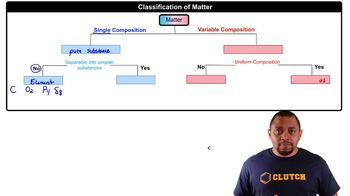
Matter Composition

Molar Mass and Molecular Formula

The molar mass of a compound is the mass of one mole of its entities, typically expressed in grams per mole. For chloral hydrate, the given molar mass of 165.4 g/mol helps in calculating the molecular formula from the empirical formula derived from the percent composition. This relationship is essential for accurately drawing the Lewis structure.
추천 영상:
가이드 코스
02:11
Molar Mass Concept

Lewis Structures and Bonding

Lewis structures are diagrams that represent the bonding between atoms in a molecule and the lone pairs of electrons. They are essential for visualizing how atoms are connected and the arrangement of electrons. In this case, the instruction to assume specific bonds (C–C and C–O) guides the drawing of the Lewis structure for chloral hydrate, illustrating its molecular geometry.
추천 영상:
가이드 코스
03:26
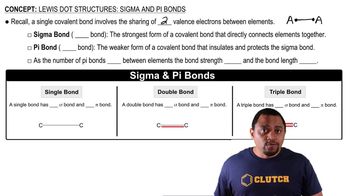
Lewis Dot Structures: Sigma & Pi Bonds
관련 실천
교과서 질문

Acetylene (C2H2) and nitrogen (N2) both contain a triple bond, but they differ greatly in their chemical properties. (c) Write balanced chemical equations for the complete oxidation of N2 to form N2O5(g) and of acetylene to form CO2(g) and H2O(g). Write a balanced chemical equation for the complete oxidation of acetylene to form CO2(g) and H2O(g).

350
views
교과서 질문

Acetylene (C2H2) and nitrogen (N2) both contain a triple bond, but they differ greatly in their chemical properties. (b) By referring to Appendix C, look up the enthalpies of formation of acetylene and nitrogen. Which compound is more stable?

344
views
교과서 질문

One scale for electronegativity is based on the concept that the electronegativity of any atom is proportional to the ionization energy of the atom minus its electron affinity: electronegativity = k1I - EA2, where k is a proportionality constant. (b) Why are both ionization energy and electron affinity relevant to the notion of electronegativity?

1070
views
교과서 질문

One scale for electronegativity is based on the concept that the electronegativity of any atom is proportional to the ionization energy of the atom minus its electron affinity: electronegativity = k1I - EA2, where k is a proportionality constant. (c) By using data in Chapter 7, determine the value of k that would lead to an electronegativity of 4.0 for F under this definition.

1085
views
교과서 질문

One scale for electronegativity is based on the concept that the electronegativity of any atom is proportional to the ionization energy of the atom minus its electron affinity: electronegativity = k1I - EA2, where k is a proportionality constant. (d) Use your result from part (c) to determine the electronegativities of Cl and O using this scale. Use your result to determine the electronegativity of Cl using this scale.

469
views