Ch.9 - Molecular Geometry and Bonding Theories
Brown - Chemistry: The Central Science 14th Edition
Brown14th EditionChemistry: The Central ScienceISBN: 9780134414232당신이 사용하는 게 아니라요?교과서 변경
9장, 문제 93c

An AB5 molecule adopts the geometry shown here. (c) Suppose the B atoms are halogen atoms. Of which group in the periodic table is atom A a member: (i) Group 15, (ii) Group 16, (iii) Group 17, (iv) Group 18, or (v) More information is needed?
Diagram of an AB5 molecule showing atom A at the center with five B atoms around it.

검증된 단계별 안내
1
Identify the geometry of the AB5 molecule. The image shows a trigonal bipyramidal geometry.
Determine the number of valence electrons for atom A. In a trigonal bipyramidal geometry, atom A must have 5 bonding pairs and no lone pairs.
Recall that halogen atoms (B) belong to Group 17 and each contributes 1 electron to the bond.
Calculate the total number of valence electrons needed for the AB5 molecule. Since there are 5 B atoms, each contributing 1 electron, atom A must provide 5 electrons.
Conclude that atom A must have 5 valence electrons, which corresponds to Group 15 in the periodic table.

비슷한 문제에 대한 검증된 영상 답변:

이 영상 해법은 위 문제에 도움이 된다고 튜터들이 추천한 것입니다.
영상 길이:
1m
도움이 되었나요?

주요 개념

질문에 올바르게 답하기 위해 반드시 이해해야 하는 핵심 개념들은 다음과 같습니다.

Molecular Geometry

Molecular geometry refers to the three-dimensional arrangement of atoms within a molecule. In the case of an AB5 molecule, the central atom A is surrounded by five B atoms, which typically leads to a trigonal bipyramidal geometry. Understanding molecular geometry is crucial for predicting the shape and reactivity of molecules, as it influences properties such as polarity and intermolecular interactions.
추천 영상:
가이드 코스
01:33
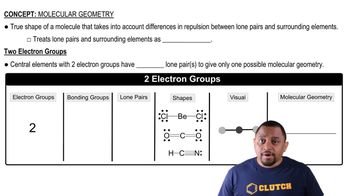
Molecular Geometry with Two Electron Groups

Periodic Table Groups

The periodic table is organized into groups, which are vertical columns that share similar chemical properties. Group 15 includes nitrogen and phosphorus, Group 16 includes oxygen and sulfur, Group 17 includes halogens like fluorine and chlorine, and Group 18 consists of noble gases such as helium and neon. Identifying the group of atom A is essential for understanding its chemical behavior and bonding characteristics with the halogen B atoms.
추천 영상:
가이드 코스
05:33
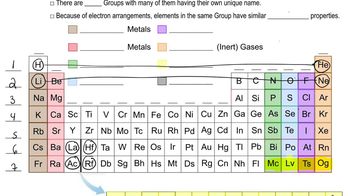
Periodic Table: Group Names

Valence Electrons and Bonding

Valence electrons are the outermost electrons of an atom and play a key role in chemical bonding. The number of valence electrons determines how an atom interacts with others, including the formation of covalent bonds. In the context of the AB5 molecule, knowing the valence electron configuration of atom A helps in predicting its ability to bond with five halogen atoms, which typically have seven valence electrons and form single covalent bonds.
추천 영상:
가이드 코스
02:12
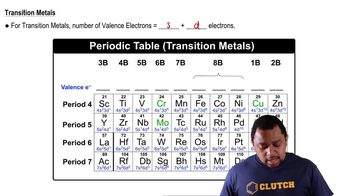
Transition Metals Valence Electrons