Ch.9 - Molecular Geometry and Bonding Theories
Brown - Chemistry: The Central Science 14th Edition
Brown14th EditionChemistry: The Central ScienceISBN: 9780134414232당신이 사용하는 게 아니라요?교과서 변경
9장, 문제 95b

The O¬H bond lengths in the water molecule 1H2O2 are 96 pm, and the H¬O¬H angle is 104.5°. The dipole moment of the water molecule is 1.85 D. (b) Calculate the magnitude of the bond dipole of the O¬H bonds. (Note: You will need to use vector addition to do this.)

검증된 단계별 안내
1
Identify the given values: the dipole moment of the water molecule (\( \mu = 1.85 \) D), the O-H bond length (96 pm), and the H-O-H bond angle (104.5°).
Understand that the dipole moment of the water molecule is the vector sum of the dipole moments of the two O-H bonds.
Use the formula for the dipole moment of a bond: \( \mu_{bond} = q \times d \), where \( q \) is the charge and \( d \) is the bond length. Here, we need to find \( \mu_{bond} \).
Apply vector addition to find the resultant dipole moment of the molecule. Since the molecule is bent, use the angle between the bonds (104.5°) to resolve the dipole moments into components and sum them vectorially.
Use the law of cosines or trigonometric identities to relate the molecular dipole moment to the bond dipole moments, considering the angle between them. Solve for the bond dipole moment.

비슷한 문제에 대한 검증된 영상 답변:

이 영상 해법은 위 문제에 도움이 된다고 튜터들이 추천한 것입니다.
영상 길이:
2m

주요 개념

질문에 올바르게 답하기 위해 반드시 이해해야 하는 핵심 개념들은 다음과 같습니다.

Bond Dipole Moment

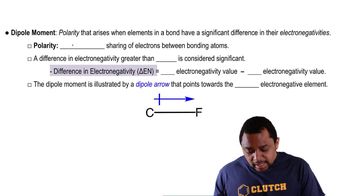
The bond dipole moment is a measure of the polarity of a bond, arising from the difference in electronegativity between the bonded atoms. In a polar bond, the electron density is unevenly distributed, creating a dipole with a positive and a negative end. The bond dipole is represented as a vector, with its magnitude proportional to the charge difference and the distance between the charges.
추천 영상:

Vector Addition

Vector addition is a mathematical process used to combine vectors, which have both magnitude and direction. In the context of dipole moments, the individual bond dipoles of a molecule can be represented as vectors that need to be added together to find the resultant dipole moment. This involves considering both the magnitudes of the dipoles and their angles relative to each other.
추천 영상:
가이드 코스
02:55
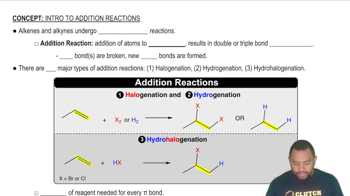
Addition Reactions

Molecular Geometry

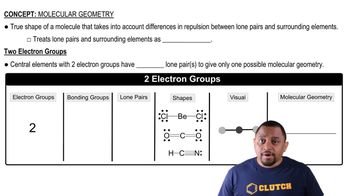
Molecular geometry refers to the three-dimensional arrangement of atoms within a molecule. The shape of a molecule, determined by bond angles and bond lengths, influences its physical and chemical properties, including polarity. In water (H2O), the bent shape due to the 104.5° H-O-H angle contributes to its overall dipole moment, affecting how it interacts with other molecules.
추천 영상:
가이드 코스
01:33
Molecular Geometry with Two Electron Groups