Ch.9 - Molecular Geometry and Bonding Theories
Brown - Chemistry: The Central Science 14th Edition
Brown14th EditionChemistry: The Central ScienceISBN: 9780134414232당신이 사용하는 게 아니라요?교과서 변경
9장, 문제 49a,b

Consider the molecule BF3. (a) What is the electron configuration of an isolated B atom? (b) What is the electron configuration of an isolated F atom?

검증된 단계별 안내
1
To determine the electron configuration of an isolated B (Boron) atom, first identify its atomic number, which is 5. This means a neutral Boron atom has 5 electrons.
Write the electron configuration for Boron by filling the orbitals in order of increasing energy: 1s, 2s, 2p. The configuration is: 1s22s22p1.
Next, consider the isolated F (Fluorine) atom. Its atomic number is 9, indicating it has 9 electrons.
Write the electron configuration for Fluorine by filling the orbitals in order of increasing energy: 1s, 2s, 2p. The configuration is: 1s22s22p5.
These configurations show how electrons are distributed in the atomic orbitals of Boron and Fluorine, which is essential for understanding their chemical behavior and bonding in molecules like BF3.

비슷한 문제에 대한 검증된 영상 답변:

이 영상 해법은 위 문제에 도움이 된다고 튜터들이 추천한 것입니다.
영상 길이:
4m
도움이 되었나요?

주요 개념

질문에 올바르게 답하기 위해 반드시 이해해야 하는 핵심 개념들은 다음과 같습니다.

Electron Configuration

Electron configuration describes the distribution of electrons in an atom's orbitals. It is represented using a notation that indicates the energy levels and sublevels occupied by electrons. For example, the electron configuration of a neutral boron (B) atom, which has 5 electrons, is 1s² 2s² 2p¹, while fluorine (F), with 9 electrons, has the configuration 1s² 2s² 2p⁵.
추천 영상:
가이드 코스
01:33
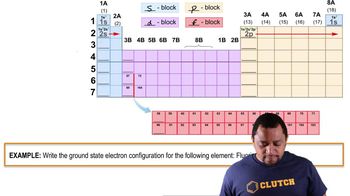
Electron Configuration Example

Atomic Structure

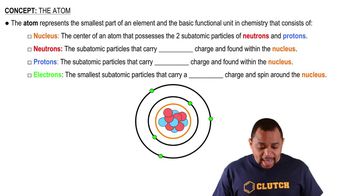
The atomic structure refers to the arrangement of protons, neutrons, and electrons within an atom. The nucleus contains protons and neutrons, while electrons orbit the nucleus in defined energy levels. Understanding atomic structure is essential for determining electron configurations, as it helps explain how electrons fill available orbitals based on energy levels and the principles of quantum mechanics.
추천 영상:

Periodic Table Trends

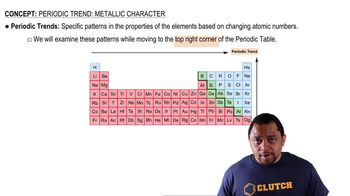
The periodic table organizes elements based on their atomic number and electron configurations, revealing trends in properties such as electronegativity, ionization energy, and atomic radius. Elements in the same group often exhibit similar electron configurations in their outer shells, which influences their chemical behavior. For instance, boron and fluorine are in different groups, leading to distinct electron configurations and reactivity patterns.
추천 영상:
가이드 코스
00:38
Periodic Trends