Ch.9 - Molecular Geometry and Bonding Theories
Brown - Chemistry: The Central Science 14th Edition
Brown14th EditionChemistry: The Central ScienceISBN: 9780134414232당신이 사용하는 게 아니라요?교과서 변경
9장, 문제 49c

Consider the molecule BF3. (c) What hybrid orbitals should be constructed on the B atom to make the B–F bonds in BF3?

검증된 단계별 안내
1
Step 1: Identify the central atom in the molecule. In this case, the central atom is Boron (B).
Step 2: Determine the number of electron domains around the central atom. An electron domain is any area where electrons are most likely to be found, such as a single bond, double bond, triple bond, or a lone pair of electrons. In BF3, Boron forms single bonds with three Fluorine atoms, so there are three electron domains.
Step 3: Use the number of electron domains to determine the hybridization of the central atom. In this case, three electron domains correspond to sp2 hybridization.
Step 4: The sp2 hybridization means that one s orbital and two p orbitals on Boron are mixed to form three new sp2 hybrid orbitals.
Step 5: These sp2 hybrid orbitals are then used to form bonds with the Fluorine atoms in BF3.

비슷한 문제에 대한 검증된 영상 답변:

이 영상 해법은 위 문제에 도움이 된다고 튜터들이 추천한 것입니다.
영상 길이:
43s
도움이 되었나요?

주요 개념

질문에 올바르게 답하기 위해 반드시 이해해야 하는 핵심 개념들은 다음과 같습니다.

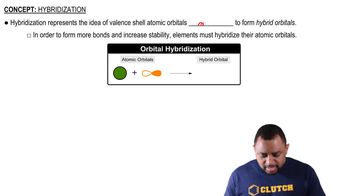
Hybridization

Hybridization is the process of combining atomic orbitals to form new hybrid orbitals that can accommodate bonding. In BF3, the boron atom undergoes sp2 hybridization, which involves mixing one s orbital and two p orbitals to create three equivalent sp2 hybrid orbitals. This allows boron to form three sigma bonds with fluorine atoms.
추천 영상:

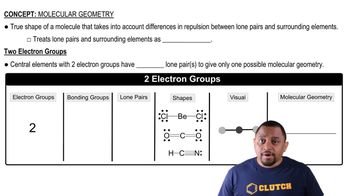
Molecular Geometry

Molecular geometry refers to the three-dimensional arrangement of atoms in a molecule. In the case of BF3, the sp2 hybridization leads to a trigonal planar geometry, where the three B–F bonds are arranged at 120-degree angles around the boron atom. Understanding molecular geometry is crucial for predicting the shape and reactivity of molecules.
추천 영상:
가이드 코스
01:33
Molecular Geometry with Two Electron Groups

Bonding and Lone Pairs

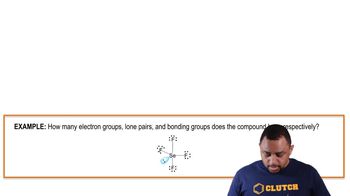
In covalent bonding, atoms share electrons to achieve stability. In BF3, boron forms three bonds with fluorine atoms, utilizing its sp2 hybrid orbitals. Importantly, boron has an incomplete octet, as it does not have any lone pairs of electrons, which influences its reactivity and the overall electron deficiency of the molecule.
추천 영상:
가이드 코스
00:51
Electron Groups, Lone Pairs, and Bonding Groups Example