For each statement, indicate whether it is true or false. (d) Nonbonding electron pairs cannot occupy a hybrid orbital.
Ch.9 - Molecular Geometry and Bonding Theories
9장, 문제 48
How would you expect the extent of overlap of the bonding atomic orbitals to vary in the series IF, ICl, IBr, and I2? Explain your answer.
검증된 단계별 안내1
Identify the concept of atomic orbital overlap: The extent of overlap between atomic orbitals is crucial for bond strength. Greater overlap generally leads to stronger bonds.
Consider the size of the halogen atoms: As you move down the halogen group in the periodic table (F, Cl, Br, I), the atomic size increases.
Analyze the effect of atomic size on overlap: Larger atoms have more diffuse orbitals, which can lead to less effective overlap compared to smaller atoms.
Compare the pairs: In the series IF, ICl, IBr, and I2, the overlap is expected to be greatest in IF and least in I2, as fluorine is the smallest atom and iodine is the largest.
Conclude with the trend: The extent of overlap decreases as the size of the halogen atom bonded to iodine increases, leading to weaker bonds in the order IF > ICl > IBr > I2.

비슷한 문제에 대한 검증된 영상 답변:
이 영상 해법은 위 문제에 도움이 된다고 튜터들이 추천한 것입니다.
영상 길이:
2m주요 개념
질문에 올바르게 답하기 위해 반드시 이해해야 하는 핵심 개념들은 다음과 같습니다.
Atomic Orbitals
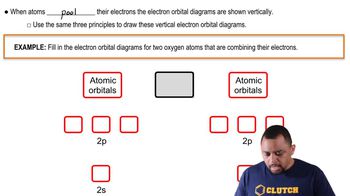
Atomic orbitals are regions in an atom where there is a high probability of finding electrons. They come in different shapes (s, p, d, f) and sizes, which influence how atoms bond with each other. The overlap of atomic orbitals between two atoms is crucial for the formation of covalent bonds, as greater overlap typically leads to stronger bonds.
추천 영상:
가이드 코스
Atomic Orbitals Example
Bonding and Overlap
The extent of overlap between atomic orbitals is a key factor in determining the strength and stability of a covalent bond. When two atomic orbitals overlap significantly, they can share electrons more effectively, resulting in a stronger bond. In the context of the given compounds, the size and electronegativity of the atoms involved will affect how well their orbitals can overlap.
추천 영상:
가이드 코스
Bond Angles
Electronegativity and Bonding Characteristics
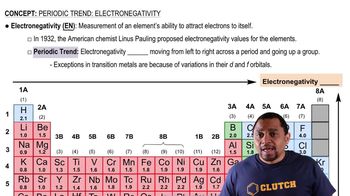
Electronegativity is a measure of an atom's ability to attract and hold onto electrons. In the series IF, ICl, IBr, and I2, the differences in electronegativity between iodine and the other halogens (F, Cl, Br) will influence the nature of the bonds formed. Higher electronegativity differences can lead to more polar bonds, affecting the overlap of bonding orbitals and the overall bond strength.
추천 영상:
가이드 코스
Electronegativity Trends
관련 실천
교과서 질문
520
views
교과서 질문
Draw sketches illustrating the overlap between the following orbitals on two atoms: (a) the 2s orbital on each atom
589
views
1
rank
교과서 질문
Consider the SCl2 molecule. (c) What hybrid orbitals should be constructed on the S atom to make the S-Cl bonds in SCl2?
807
views
교과서 질문
Consider the molecule BF3. (c) What hybrid orbitals should be constructed on the B atom to make the B–F bonds in BF3?
987
views
교과서 질문
Consider the molecule BF3. (a) What is the electron configuration of an isolated B atom? (b) What is the electron configuration of an isolated F atom?
교과서 질문
Draw sketches illustrating the overlap between the following orbitals on two atoms: (b) the 2pz orbital on each atom (assume both atoms are on the z-axis) (c) the 2s orbital on one atom and the 2pz orbital on the other atom.
929
views