Ch.9 - Molecular Geometry and Bonding Theories
Brown - Chemistry: The Central Science 14th Edition
Brown14th EditionChemistry: The Central ScienceISBN: 9780134414232당신이 사용하는 게 아니라요?교과서 변경
9장, 문제 74d

Indicate whether each statement is true or false. (d) Electrons cannot occupy a nonbonding orbital.

검증된 단계별 안내
1
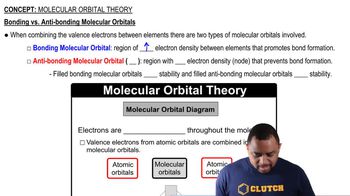
Understand the concept of molecular orbitals: Molecular orbitals are formed by the combination of atomic orbitals when atoms bond together. These orbitals can be bonding, antibonding, or nonbonding.
Define nonbonding orbitals: Nonbonding orbitals are molecular orbitals that are not involved in bonding. They are typically associated with lone pairs of electrons on an atom.
Consider the occupancy of nonbonding orbitals: Electrons can occupy nonbonding orbitals, as these orbitals are often filled with lone pair electrons that do not participate in bonding.
Evaluate the statement: The statement 'Electrons cannot occupy a nonbonding orbital' is incorrect because nonbonding orbitals can indeed be occupied by electrons.
Conclude the analysis: Based on the understanding of nonbonding orbitals and electron occupancy, the statement is false.

비슷한 문제에 대한 검증된 영상 답변:

이 영상 해법은 위 문제에 도움이 된다고 튜터들이 추천한 것입니다.
영상 길이:
1m
도움이 되었나요?

주요 개념

질문에 올바르게 답하기 위해 반드시 이해해야 하는 핵심 개념들은 다음과 같습니다.

Nonbonding Orbitals

Nonbonding orbitals are molecular orbitals that do not participate in bonding between atoms. They are typically filled with electrons that are localized on a single atom and do not contribute to the overall stability of the molecule through bonding interactions. Understanding the nature of these orbitals is crucial for determining the electronic structure of molecules.
추천 영상:
가이드 코스
03:06
Molecular Orbital Theory

Electron Configuration

Electron configuration refers to the distribution of electrons in an atom's orbitals. Each orbital can hold a specific number of electrons, and the arrangement of these electrons determines the chemical properties of the element. In the context of nonbonding orbitals, it is important to recognize that electrons can occupy these orbitals, which influences molecular geometry and reactivity.
추천 영상:
가이드 코스
01:33
Electron Configuration Example

Molecular Orbital Theory

Molecular Orbital Theory describes the behavior of electrons in molecules by considering the combination of atomic orbitals to form molecular orbitals. These orbitals can be bonding, antibonding, or nonbonding. This theory helps explain the stability and properties of molecules, including the role of nonbonding orbitals in influencing molecular shape and electron distribution.
추천 영상:
가이드 코스
03:06
Molecular Orbital Theory