
Ch.11 - Liquids & Phase Changes
McMurry - Chemistry 8th Edition
McMurry8th EditionChemistryISBN: 9781292336145당신이 사용하는 게 아니라요?교과서 변경
11장, 문제 22

Predict which substance in each pair has the highest surface tension.(a) CCl4 or CH2Br2

검증된 단계별 안내
1
Identify the molecular structures of both CCl4 (carbon tetrachloride) and CH2Br2 (dibromomethane). CCl4 has a tetrahedral structure with four chlorine atoms symmetrically arranged around a central carbon atom. CH2Br2 also has a tetrahedral structure around the central carbon but with two hydrogen atoms and two bromine atoms.
Consider the types of intermolecular forces present in each substance. CCl4 has only London dispersion forces because it is nonpolar. CH2Br2 has both London dispersion forces and dipole-dipole interactions due to its polar nature.
Compare the strengths of the intermolecular forces. Dipole-dipole interactions (present in CH2Br2) are generally stronger than London dispersion forces alone (present in CCl4).
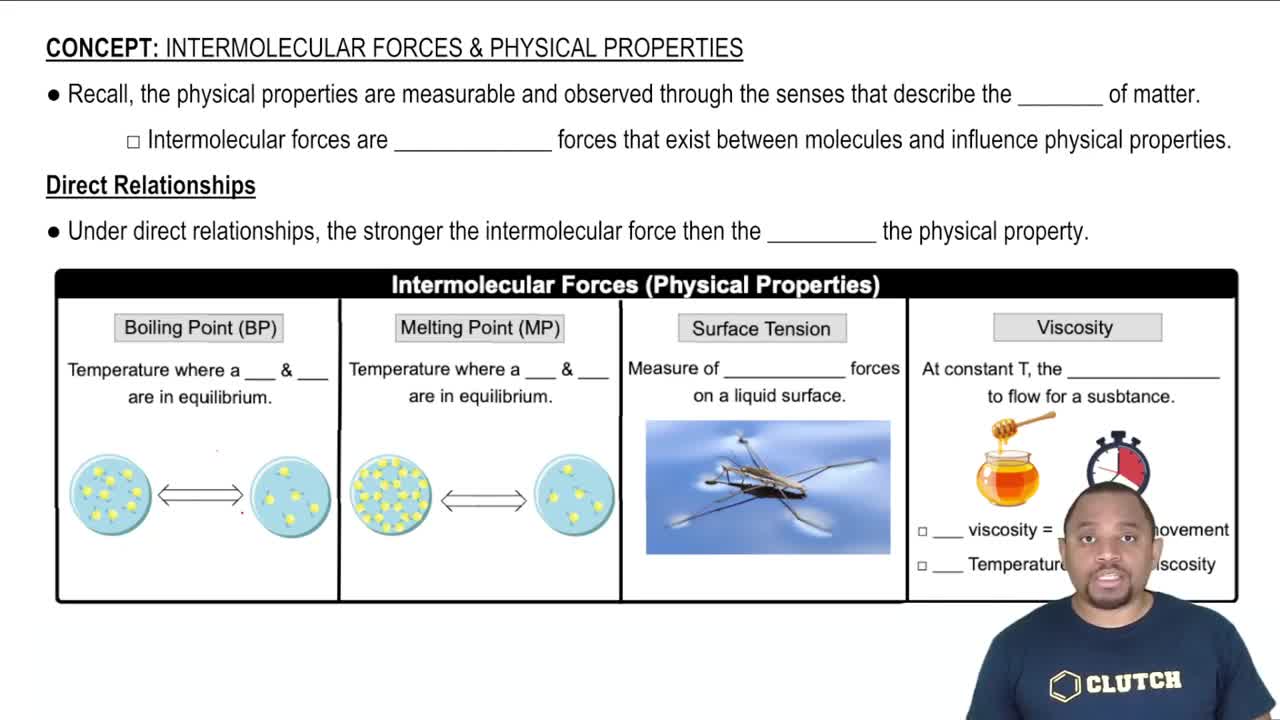
Recall that surface tension is influenced by the strength of intermolecular forces. Substances with stronger intermolecular forces typically exhibit higher surface tension.
Conclude which substance likely has the higher surface tension based on the types and strengths of intermolecular forces present. In this case, CH2Br2 with both dipole-dipole interactions and London dispersion forces likely has a higher surface tension compared to CCl4, which only exhibits London dispersion forces.

비슷한 문제에 대한 검증된 영상 답변:

이 영상 해법은 위 문제에 도움이 된다고 튜터들이 추천한 것입니다.
영상 길이:
4m
도움이 되었나요?

주요 개념

질문에 올바르게 답하기 위해 반드시 이해해야 하는 핵심 개념들은 다음과 같습니다.

Surface Tension

Surface tension is a physical property of liquids that describes the elastic-like force at the surface, which makes it behave as if it were covered by a stretched elastic membrane. It arises from the cohesive forces between liquid molecules, which are stronger at the surface due to the imbalance of intermolecular forces. Higher surface tension indicates a greater ability of a liquid to resist external forces.
추천 영상:
가이드 코스
03:13
Intermolecular Forces and Properties

Intermolecular Forces

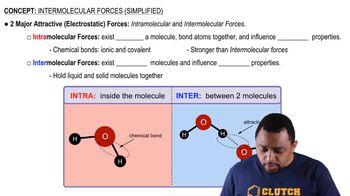
Intermolecular forces are the forces of attraction or repulsion between neighboring particles (atoms, molecules, or ions). These forces include hydrogen bonding, dipole-dipole interactions, and London dispersion forces. The strength and type of these forces significantly influence a substance's physical properties, including surface tension, with stronger intermolecular forces typically leading to higher surface tension.
추천 영상:
가이드 코스
01:59
Intermolecular vs Intramolecular Forces

Molecular Structure and Polarity

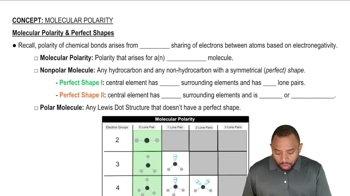
The molecular structure and polarity of a substance play a crucial role in determining its surface tension. Polar molecules, which have a significant difference in electronegativity between atoms, tend to have stronger intermolecular forces due to dipole interactions. In contrast, nonpolar molecules exhibit weaker London dispersion forces. Understanding the polarity and structure of CCl4 and CH2Br2 is essential for predicting which has higher surface tension.
추천 영상:
가이드 코스
02:38
Molecular Polarity