Ch.11 - Liquids & Phase Changes
McMurry - Chemistry 8th Edition
McMurry8th EditionChemistryISBN: 9781292336145당신이 사용하는 게 아니라요?교과서 변경
11장, 문제 23a

Predict which substance in each pair has the highest viscosity. (a) Hexane 1CH3CH2CH2CH2CH2CH32 or 1-hexanol 1CH3CH2CH2CH2CH2CH2OH2

검증된 단계별 안내
1
Identify the molecular structure of each substance: Hexane is a hydrocarbon with the formula \( \text{C}_6\text{H}_{14} \), while 1-hexanol is an alcohol with the formula \( \text{C}_6\text{H}_{13}\text{OH} \).
Consider the intermolecular forces present in each substance: Hexane, being a nonpolar molecule, primarily exhibits London dispersion forces. 1-hexanol, on the other hand, is capable of hydrogen bonding due to the presence of the hydroxyl (\( \text{OH} \)) group.
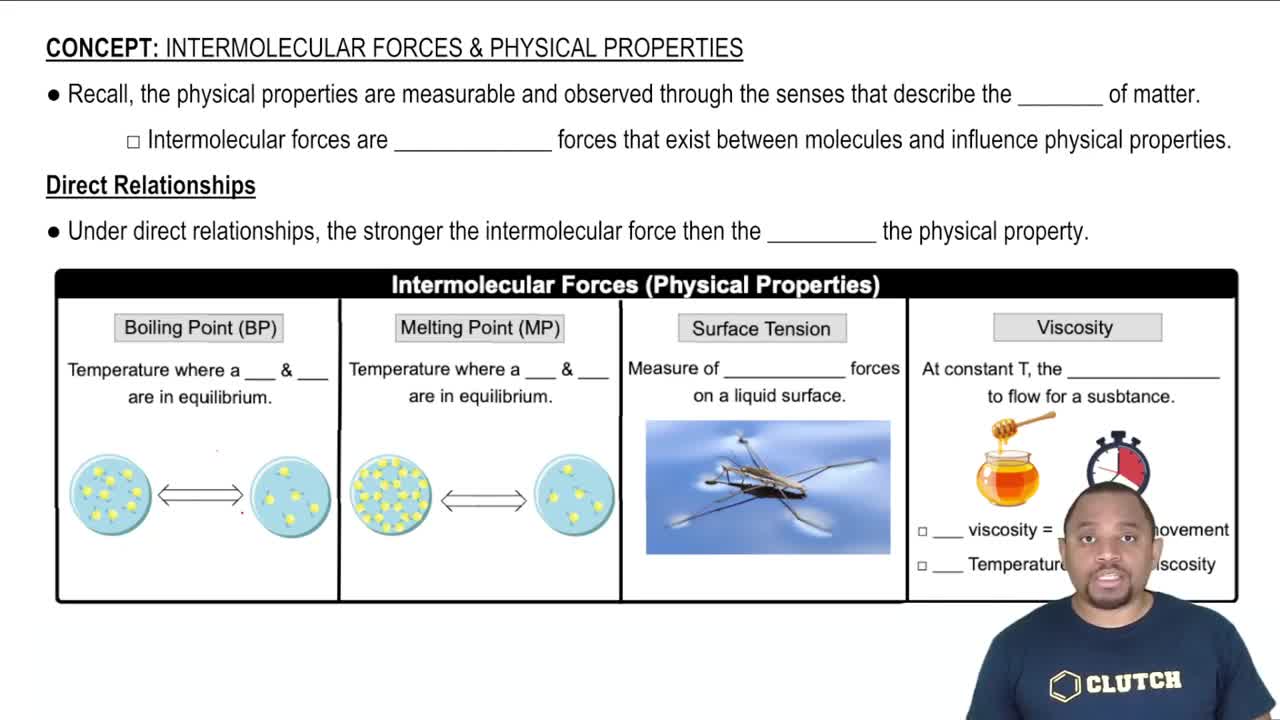
Understand that viscosity is influenced by the strength of intermolecular forces: Stronger intermolecular forces generally lead to higher viscosity because the molecules are more strongly attracted to each other, making it harder for them to flow past one another.
Compare the intermolecular forces: Since hydrogen bonding is stronger than London dispersion forces, 1-hexanol will have stronger intermolecular forces compared to hexane.
Predict the substance with the highest viscosity: Based on the stronger intermolecular forces due to hydrogen bonding, 1-hexanol is expected to have a higher viscosity than hexane.

비슷한 문제에 대한 검증된 영상 답변:

이 영상 해법은 위 문제에 도움이 된다고 튜터들이 추천한 것입니다.
영상 길이:
2m
도움이 되었나요?

주요 개념

질문에 올바르게 답하기 위해 반드시 이해해야 하는 핵심 개념들은 다음과 같습니다.

Viscosity

Viscosity is a measure of a fluid's resistance to flow. It reflects how easily molecules within a substance can move past one another. Higher viscosity indicates a thicker fluid that flows more slowly, while lower viscosity corresponds to a thinner fluid that flows more easily. Factors influencing viscosity include temperature, molecular size, and intermolecular forces.
추천 영상:
가이드 코스
03:13
Intermolecular Forces and Properties

Intermolecular Forces

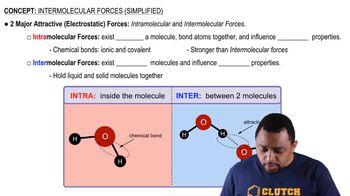
Intermolecular forces are the attractive forces between molecules that influence physical properties such as boiling point, melting point, and viscosity. These forces include hydrogen bonding, dipole-dipole interactions, and London dispersion forces. Substances with stronger intermolecular forces typically exhibit higher viscosity due to the increased energy required to overcome these attractions during flow.
추천 영상:
가이드 코스
01:59
Intermolecular vs Intramolecular Forces

Hydroxyl Group

The hydroxyl group (-OH) is a functional group found in alcohols, such as 1-hexanol. This group is capable of forming hydrogen bonds, which significantly increases the viscosity of the substance compared to hydrocarbons like hexane that lack such polar functional groups. The presence of the hydroxyl group enhances intermolecular interactions, leading to a thicker, more viscous liquid.
추천 영상: