

Ch.13 - Solutions & Their Properties
McMurry - Chemistry 8th Edition
McMurry8th EditionChemistryISBN: 9781292336145당신이 사용하는 게 아니라요?교과서 변경
13장, 문제 44

Br₂ is much more soluble in tetrachloromethane (CCl₄) than in water. Explain.

검증된 단계별 안내
1
Step 1: Understand the nature of the solute and solvents involved. Bromine (Br₂) is a nonpolar molecule, while tetrachloromethane (CCl₄) is also nonpolar. Water, on the other hand, is a polar solvent.
Step 2: Recall the principle 'like dissolves like,' which means that nonpolar solutes tend to dissolve well in nonpolar solvents, and polar solutes dissolve well in polar solvents.
Step 3: Analyze the interactions. In a nonpolar solvent like CCl₄, Br₂ molecules can interact through London dispersion forces, which are weak intermolecular forces that occur between nonpolar molecules.
Step 4: Consider the interactions in water. Water molecules are polar and can form hydrogen bonds, which are strong intermolecular forces. Br₂, being nonpolar, cannot effectively interact with water molecules, leading to poor solubility.
Step 5: Conclude that the solubility of Br₂ in CCl₄ is higher than in water because the nonpolar Br₂ molecules are more compatible with the nonpolar CCl₄, allowing for better solvation through dispersion forces.

주요 개념

질문에 올바르게 답하기 위해 반드시 이해해야 하는 핵심 개념들은 다음과 같습니다.

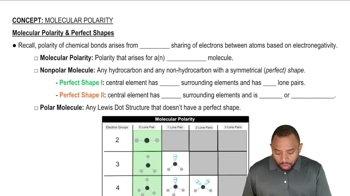
Polarity of Solvents

Solubility is greatly influenced by the polarity of solvents. Water is a polar solvent, meaning it has a significant dipole moment due to its molecular structure, which allows it to interact well with other polar substances. In contrast, tetrachloromethane (CCl₄) is a nonpolar solvent, which interacts more effectively with nonpolar solutes like Br₂, leading to higher solubility.
추천 영상:
가이드 코스
02:38
Molecular Polarity

Like Dissolves Like Principle

The principle of 'like dissolves like' states that polar solvents dissolve polar solutes, while nonpolar solvents dissolve nonpolar solutes. Since Br₂ is a nonpolar molecule, it is more soluble in nonpolar solvents like CCl₄ than in polar solvents like water. This principle helps predict solubility behavior based on the nature of the solute and solvent.
추천 영상:
가이드 코스
02:05
Uncertainty Principle Formula

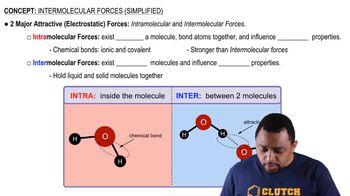
Intermolecular Forces

Intermolecular forces play a crucial role in solubility. In water, hydrogen bonding and dipole-dipole interactions dominate, which do not favor the dissolution of nonpolar substances like Br₂. In CCl₄, the weak London dispersion forces allow for better interaction with Br₂, facilitating its solubility in the nonpolar environment.
추천 영상:
가이드 코스
01:59
Intermolecular vs Intramolecular Forces