Ch.7 - Covalent Bonding and Electron-Dot Structures
McMurry - Chemistry 8th Edition
McMurry8th EditionChemistryISBN: 9781292336145당신이 사용하는 게 아니라요?교과서 변경
7장, 문제 59b

Using only the elements Ca, Cl, and Si, give formulas for the following. (b) A molecular compound with polar covalent bonds that obeys the octet rule and has no formal charges

검증된 단계별 안내
1
insert step 1: Identify the elements involved in the problem: Calcium (Ca), Chlorine (Cl), and Silicon (Si).
insert step 2: Recognize that a molecular compound typically involves nonmetals, so focus on Cl and Si for forming a molecular compound.
insert step 3: Consider the octet rule, which states that atoms tend to form bonds until they are surrounded by eight electrons.
insert step 4: Determine the possible compound by combining Si and Cl, as Si can form four covalent bonds to satisfy the octet rule.
insert step 5: Write the chemical formula for the compound, ensuring that it has polar covalent bonds and no formal charges.

비슷한 문제에 대한 검증된 영상 답변:

이 영상 해법은 위 문제에 도움이 된다고 튜터들이 추천한 것입니다.
영상 길이:
5m
도움이 되었나요?

주요 개념

질문에 올바르게 답하기 위해 반드시 이해해야 하는 핵심 개념들은 다음과 같습니다.

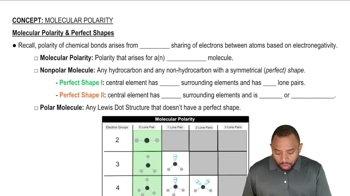
Polar Covalent Bonds

Polar covalent bonds occur when two atoms share electrons unequally due to differences in electronegativity. In such bonds, the atom with higher electronegativity attracts the shared electrons more strongly, resulting in a partial negative charge on that atom and a partial positive charge on the other. This uneven distribution of charge creates a dipole moment, making the molecule polar.
추천 영상:
가이드 코스
02:38
Molecular Polarity

Octet Rule

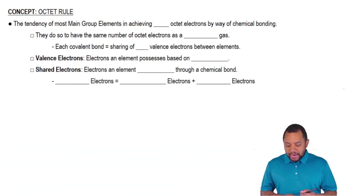
The octet rule is a chemical principle stating that atoms tend to bond in such a way that they each have eight electrons in their valence shell, achieving a stable electron configuration similar to that of noble gases. This rule is particularly relevant for main group elements and guides the formation of covalent bonds, ensuring that atoms share or transfer electrons to fulfill this requirement.
추천 영상:

Formal Charge

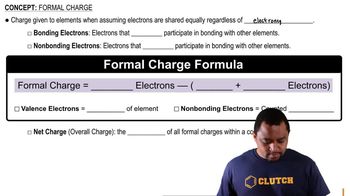
Formal charge is a theoretical charge assigned to an atom in a molecule, calculated based on the number of valence electrons, the number of non-bonding electrons, and half the number of bonding electrons. It helps in determining the most stable Lewis structure for a molecule. A stable molecular structure typically has formal charges close to zero, indicating that the distribution of electrons is balanced and that the molecule is energetically favorable.
추천 영상: