Ch.7 - Covalent Bonding and Electron-Dot Structures
McMurry - Chemistry 8th Edition
McMurry8th EditionChemistryISBN: 9781292336145당신이 사용하는 게 아니라요?교과서 변경
7장, 문제 64

Why does the octet rule apply primarily to main-group elements, not to transition metals?

검증된 단계별 안내
1
Understand the electron configuration: Main-group elements have valence electrons in their outermost s and p orbitals, which can hold up to eight electrons. This configuration leads to the octet rule, where atoms tend to gain, lose, or share electrons to achieve a stable set of eight valence electrons.
Recognize the difference in transition metals: Transition metals have their valence electrons in the d orbitals, which can hold up to ten electrons. This allows transition metals to have a variety of oxidation states and complex electron configurations beyond the simple octet.
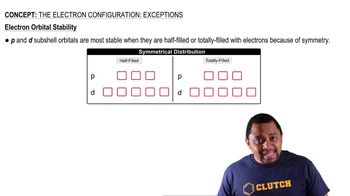
Consider the stability of filled and half-filled subshells: Transition metals often achieve stability not just by reaching an octet but also by filling or half-filling their d subshells, which can confer extra stability due to exchange energy and symmetry.
Examine typical compounds and coordination complexes: Transition metals frequently form coordination complexes where they are surrounded by multiple ligands, leading to electron configurations that do not conform to the octet rule but are stable due to other factors such as crystal field stabilization.
Explore the role of the 18-electron rule: In some cases, transition metals follow the 18-electron rule, which is analogous to the octet rule but adapted for the additional capacity of the d orbitals. This rule helps predict the stability of complexes involving transition metals.

비슷한 문제에 대한 검증된 영상 답변:

이 영상 해법은 위 문제에 도움이 된다고 튜터들이 추천한 것입니다.
영상 길이:
1m
도움이 되었나요?

주요 개념

질문에 올바르게 답하기 위해 반드시 이해해야 하는 핵심 개념들은 다음과 같습니다.

Octet Rule

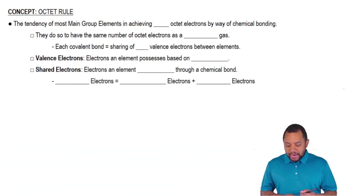
The octet rule is a chemical principle stating that atoms tend to bond in such a way that they each have eight electrons in their valence shell, achieving a stable electron configuration similar to that of noble gases. This rule primarily applies to main-group elements, which typically have their valence electrons in the s and p orbitals, allowing them to easily gain, lose, or share electrons to fulfill this requirement.
추천 영상:

Main-Group Elements vs. Transition Metals

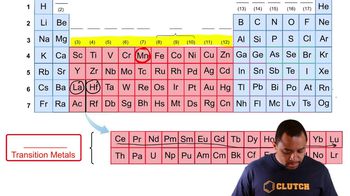
Main-group elements are found in groups 1, 2, and 13-18 of the periodic table and generally follow the octet rule due to their straightforward electron configurations. In contrast, transition metals, located in groups 3-12, have d orbitals that can accommodate additional electrons, leading to more complex bonding behavior and variable oxidation states, which often do not conform to the octet rule.
추천 영상:
가이드 코스
03:30
Transition Metals and Representative Elements

Electron Configuration and Stability

Electron configuration refers to the distribution of electrons in an atom's orbitals. For main-group elements, achieving a full valence shell (octet) is a primary means of attaining stability. Transition metals, however, can achieve stability through various electron arrangements, including partially filled d orbitals, which allows them to form diverse compounds and exhibit unique properties that do not rely solely on the octet rule.
추천 영상:
가이드 코스
01:23
Electron Orbital Stability