
Ch.10 - Gases: Their Properties & Behavior
McMurry - Chemistry 8th Edition
McMurry8th EditionChemistryISBN: 9781292336145당신이 사용하는 게 아니라요?교과서 변경
10장, 문제 149e

Chemical explosions are characterized by the instantaneous release of large quantities of hot gases, which set up a shock wave of enormous pressure (up to 700,000 atm) and velocity (up to 20,000 mi/h). For example, explosion of nitroglycerin (C3H5N3O9) releases four gases, A, B, C, and D:
n C3H5N3O9(l) a A(g) + b B(g) + c C(g) + d D(g)
Assume that the explosion of 1 mol (227 g) of nitroglycerin releases gases with a temperature of 1950 °C and a volume of 1323 L at 1.00 atm pressure.
(e) Write a balanced equation for the explosion of nitroglycerin.

검증된 단계별 안내
1
Identify the chemical formula for nitroglycerin: C_3H_5N_3O_9.
Determine the products of the explosion. Typically, nitroglycerin decomposes into gases such as CO_2, H_2O, N_2, and O_2.
Write the unbalanced chemical equation: C_3H_5N_3O_9(l) -> a CO_2(g) + b H_2O(g) + c N_2(g) + d O_2(g).
Balance the equation by ensuring the number of atoms of each element is equal on both sides. Start with carbon, then hydrogen, nitrogen, and finally oxygen.
Verify the balanced equation by counting the atoms of each element on both sides to ensure they match.

비슷한 문제에 대한 검증된 영상 답변:

이 영상 해법은 위 문제에 도움이 된다고 튜터들이 추천한 것입니다.
영상 길이:
3m

주요 개념

질문에 올바르게 답하기 위해 반드시 이해해야 하는 핵심 개념들은 다음과 같습니다.

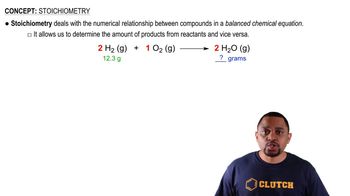
Stoichiometry

Stoichiometry is the branch of chemistry that deals with the quantitative relationships between the reactants and products in a chemical reaction. It allows chemists to predict the amounts of substances consumed and produced in a reaction based on balanced chemical equations. Understanding stoichiometry is essential for writing balanced equations, as it ensures that the law of conservation of mass is upheld.
추천 영상:
가이드 코스
01:16
Stoichiometry Concept

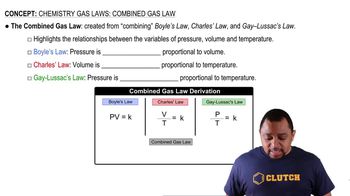
Gas Laws

Gas laws describe the behavior of gases in relation to pressure, volume, and temperature. Key laws include Boyle's Law, Charles's Law, and the Ideal Gas Law, which can be used to relate the conditions of gases produced in a reaction. In the context of explosions, these laws help in understanding how the gases behave under extreme conditions, such as high temperatures and pressures.
추천 영상:
가이드 코스
01:43
Combined Gas Law

Thermochemistry

Thermochemistry is the study of the heat energy associated with chemical reactions and phase changes. It involves understanding how energy is absorbed or released during a reaction, which is crucial for explosive reactions like that of nitroglycerin. Knowledge of thermochemistry helps in predicting the temperature and energy changes that occur during the explosion, which is vital for safety and control in chemical processes.
추천 영상:
관련 실천
교과서 질문

Combustion analysis of 0.1500 g of methyl tert-butyl ether, an octane booster used in gasoline, gave 0.3744 g of CO2 and 0.1838 g of H2O. When a flask having a volume of 1.00 L was evacuated and then filled with methyl tertbutyl ether vapor at a pressure of 100.0 kPa and a temperature of 54.8 °C, the mass of the flask increased by 3.233 g. (a) What is the empirical formula of methyl tert-butyl ether?

321
views
교과서 질문
The Rankine temperature scale used in engineering is to the Fahrenheit scale as the Kelvin scale is to the Celsius scale. That is, 1 Rankine degree is the same size as 1 Fahrenheit degree, and 0 °R = absolute zero. (b) What is the value of the gas constant R on the Rankine scale in 1L ~ atm2>1°R ~ mol2? (c) Use the van der Waals equation to determine the pressure inside a 400.0-mL vessel that contains 2.50 mol of CH4 at a temperature of 525 °R. For CH4, a = 2.253 1L2 ~ atm2>mol2 and b = 0.04278 L>mol.
597
views
교과서 질문
Combustion analysis of 0.1500 g of methyl tert-butyl ether, an octane booster used in gasoline, gave 0.3744 g of CO2 and 0.1838 g of H2O. When a flask having a volume of 1.00 L was evacuated and then filled with methyl tertbutyl ether vapor at a pressure of 100.0 kPa and a temperature of 54.8 °C, the mass of the flask increased by 3.233 g. (b) What is the molecular weight and molecular formula of methyl tert-butyl ether?
300
views
교과서 질문

Chemical explosions are characterized by the instantaneous release of large quantities of hot gases, which set up a shock wave of enormous pressure (up to 700,000 atm) and velocity (up to 20,000 mi/h). For example, explosion of nitroglycerin (C3H5N3O9) releases four gases, A, B, C, and D:

n C3H5N3O9(l) a A(g) + b B(g) + c C(g) + d D(g)

Assume that the explosion of 1 mol (227 g) of nitroglycerin releases gases with a temperature of 1950 °C and a volume of 1323 L at 1.00 atm pressure.

(d) When gases C and D were passed through a hot tube of powdered copper, gas C reacted to form CuO. The remaining gas, D, was collected in a third 500.0-mL flask and found to have a mass of 0.168 g and a pressure of 223 mm Hg at 25 °C. How many moles each of C and D were present, and what are their likely identities?

603
views
교과서 질문

Combustion analysis of 0.1500 g of methyl tert-butyl ether, an octane booster used in gasoline, gave 0.3744 g of CO2 and 0.1838 g of H2O. When a flask having a volume of 1.00 L was evacuated and then filled with methyl tertbutyl ether vapor at a pressure of 100.0 kPa and a temperature of 54.8 °C, the mass of the flask increased by 3.233 g. (c) Write a balanced equation for the combustion reaction.

304
views