Imagine that you have two identical flasks, one containing
chlorine gas and the other containing argon at the same
temperature and pressure. How can you tell which is which
without opening them?
검증된 단계별 안내
1
Step 1: Understand that both chlorine and argon are gases at room temperature and pressure. However, they have different physical and chemical properties that can be used to distinguish between them.
Step 2: Consider the color of the gases. Chlorine gas is greenish-yellow, while argon is colorless. If the flasks are transparent and one of the gases is visibly colored, it is likely to be chlorine.
Step 3: Consider the weight of the flasks. Chlorine molecules (Cl2) are heavier than argon atoms (Ar). If the flasks are identical and one is noticeably heavier, it is likely to contain chlorine.
Step 4: Consider the reactivity of the gases. Chlorine is a highly reactive gas, while argon is a noble gas and is very unreactive. If a reactive test is possible without opening the flasks, the one that reacts is likely to contain chlorine.
Step 5: If none of the above methods are possible or conclusive, advanced techniques such as spectroscopy could be used. Different substances absorb and emit light at different wavelengths, providing a unique 'fingerprint' that can be used to identify them.
비슷한 문제에 대한 검증된 영상 답변:
이 영상 해법은 위 문제에 도움이 된다고 튜터들이 추천한 것입니다.
영상 길이:
1m
영상 재생:
0 댓글
주요 개념
질문에 올바르게 답하기 위해 반드시 이해해야 하는 핵심 개념들은 다음과 같습니다.
Molar Mass
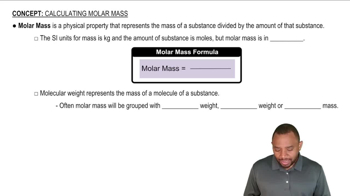
Molar mass is the mass of one mole of a substance, typically expressed in grams per mole (g/mol). Chlorine gas (Cl2) has a molar mass of approximately 70.9 g/mol, while argon (Ar) has a molar mass of about 39.9 g/mol. This difference in molar mass can affect the density of the gases, which can be used to distinguish between them.
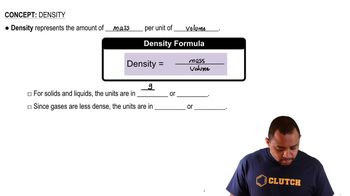
The density of a gas is defined as its mass per unit volume and is influenced by its molar mass and the conditions of temperature and pressure. Under the same conditions, a gas with a higher molar mass will have a higher density. By comparing the densities of chlorine and argon, one can determine which gas is in which flask without opening them.
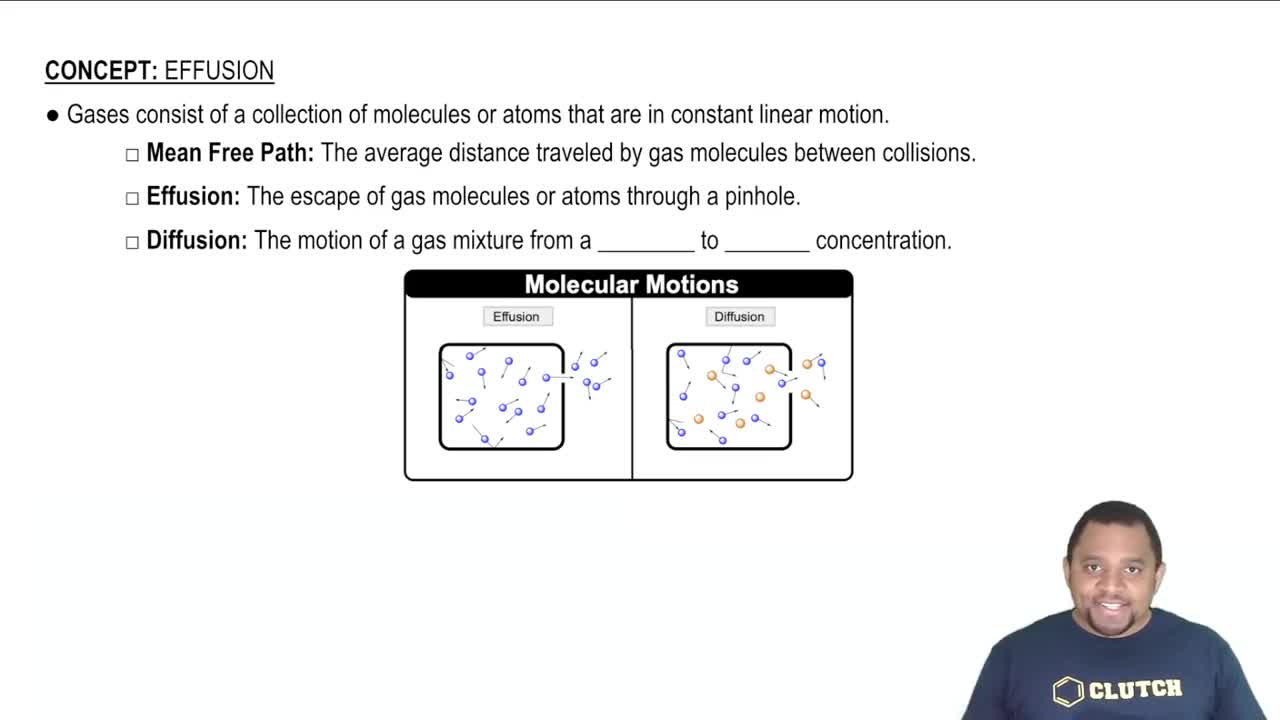
Diffusion is the process by which gas molecules spread from areas of high concentration to areas of low concentration. According to Graham's law of effusion, lighter gases diffuse faster than heavier gases. Since argon is lighter than chlorine, if there is a way to observe the rate of diffusion, it can help identify which gas is in each flask.


 검증된 단계별 안내
 02:11
02:11