Ch.11 - Liquids & Phase Changes
McMurry - Chemistry 8th Edition
McMurry8th EditionChemistryISBN: 9781292336145당신이 사용하는 게 아니라요?교과서 변경
11장, 문제 27

Assume that you have a sample of gas at 350 K in a sealed container, as represented in (a). Which of the drawings (b)–(d) represents the gas after the temperature is lowered from 350 K to 150 K? The boiling point of the gas is 90 K. Illustration of gas particles in a container at 350 K, representing phase changes for a chemistry question.

검증된 단계별 안내
1
Identify the initial state of the gas: The gas is at 350 K, which is above its boiling point of 90 K, so it is in the gaseous phase.
Understand the effect of temperature change: Lowering the temperature from 350 K to 150 K will still keep the gas above its boiling point, so it will remain in the gaseous phase.
Analyze the drawings (b)–(d): Look for the drawing that represents gas particles in a container at a lower temperature but still in the gaseous phase.
Compare the density of particles: The drawing that shows gas particles more closely packed than at 350 K but still dispersed throughout the container represents the gas at 150 K.
Select the correct drawing: Choose the drawing that matches the description of gas particles at 150 K, which should show a similar distribution to the initial state but potentially slightly denser due to the lower temperature.

비슷한 문제에 대한 검증된 영상 답변:

이 영상 해법은 위 문제에 도움이 된다고 튜터들이 추천한 것입니다.
영상 길이:
2m
도움이 되었나요?

주요 개념

질문에 올바르게 답하기 위해 반드시 이해해야 하는 핵심 개념들은 다음과 같습니다.

Kinetic Molecular Theory

The Kinetic Molecular Theory explains the behavior of gases in terms of particles in constant motion. It posits that gas particles are far apart, move freely, and collide elastically. As temperature decreases, the average kinetic energy of the particles also decreases, leading to slower movement and potential phase changes.
추천 영상:
가이드 코스
01:19
Kinetic Molecular Theory

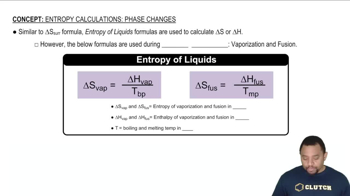
Phase Changes

Phase changes refer to the transitions between solid, liquid, and gas states of matter. When a gas is cooled, it may condense into a liquid if the temperature drops below its boiling point. In this scenario, lowering the temperature from 350 K to 150 K, which is above the boiling point of 90 K, suggests that the gas may condense into a liquid state.
추천 영상:
가이드 코스
01:46
Entropy in Phase Changes

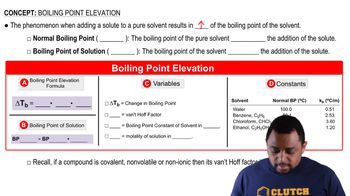
Boiling Point

The boiling point is the temperature at which a substance transitions from a liquid to a gas. For the gas in this question, the boiling point is 90 K. Since the initial temperature is 350 K and the final temperature is 150 K, the gas will remain in the gaseous state until it reaches the boiling point, after which it may condense into a liquid.
추천 영상:
가이드 코스
03:05
Boiling Point Elevation