Ch.11 - Liquids & Phase Changes
McMurry - Chemistry 8th Edition
McMurry8th EditionChemistryISBN: 9781292336145당신이 사용하는 게 아니라요?교과서 변경
11장, 문제 25

The viscosity of water at 20 °C is 1.00 * 10-3 1N • s>m2 2 higher than dimethyl sulfide 31CH322 S4 2.8 * 10-4 1N • s>m2 2. Explain the difference in viscosity based on chemical structure.

검증된 단계별 안내
1
Viscosity is a measure of a fluid's resistance to flow. It is influenced by the intermolecular forces present in the liquid.
Water (H2O) is a polar molecule with strong hydrogen bonding between its molecules. This hydrogen bonding significantly increases the viscosity of water.
Dimethyl sulfide ((CH3)2S) is a nonpolar molecule with weaker van der Waals forces (specifically London dispersion forces) between its molecules, resulting in lower viscosity.
The presence of hydrogen bonds in water creates a network of interactions that require more energy to overcome, leading to higher viscosity compared to dimethyl sulfide.
In summary, the difference in viscosity between water and dimethyl sulfide is primarily due to the strong hydrogen bonding in water, as opposed to the weaker intermolecular forces in dimethyl sulfide.

비슷한 문제에 대한 검증된 영상 답변:

이 영상 해법은 위 문제에 도움이 된다고 튜터들이 추천한 것입니다.
영상 길이:
2m

주요 개념

질문에 올바르게 답하기 위해 반드시 이해해야 하는 핵심 개념들은 다음과 같습니다.

Viscosity

Viscosity is a measure of a fluid's resistance to flow, influenced by intermolecular forces and the size and shape of its molecules. Higher viscosity indicates a thicker fluid that flows more slowly, while lower viscosity corresponds to a thinner fluid that flows more easily. In the context of water and dimethyl sulfide, the differences in viscosity can be attributed to their molecular interactions and structural characteristics.
추천 영상:
가이드 코스
03:13
Intermolecular Forces and Properties

Intermolecular Forces

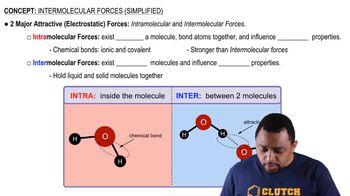
Intermolecular forces are the attractive forces between molecules that influence physical properties like boiling point, melting point, and viscosity. Water exhibits strong hydrogen bonding due to its polar nature, leading to higher viscosity. In contrast, dimethyl sulfide has weaker van der Waals forces, resulting in lower viscosity as its molecules can move past each other more easily.
추천 영상:
가이드 코스
01:59
Intermolecular vs Intramolecular Forces

Molecular Structure

The molecular structure of a substance, including its shape and the presence of functional groups, significantly affects its physical properties. Water's bent shape and polar O-H bonds create a highly cohesive liquid, while dimethyl sulfide's linear structure and sulfur atom lead to less cohesive interactions. This structural difference contributes to the observed disparity in viscosity between the two substances.
추천 영상:
가이드 코스
02:08
Molecular Formula