Ch.11 - Liquids & Phase Changes
McMurry - Chemistry 8th Edition
McMurry8th EditionChemistryISBN: 9781292336145당신이 사용하는 게 아니라요?교과서 변경
11장, 문제 23b

Predict which substance in each pair has the highest viscosity. (b) Pentane or neopentane

검증된 단계별 안내
1
Step 1: Understand the concept of viscosity. Viscosity is a measure of a fluid's resistance to flow. It describes the internal friction of a moving fluid. A fluid with large viscosity resists motion because its molecular makeup gives it a lot of internal friction. A fluid with low viscosity flows easily because its molecular makeup results in very little friction when it is in motion.
Step 2: Consider the molecular structure of the substances. Pentane is a linear molecule, while neopentane is a branched molecule. The shape of the molecule can affect its ability to flow and thus its viscosity.
Step 3: Consider the intermolecular forces. Both pentane and neopentane are nonpolar molecules, so the primary intermolecular force is London dispersion forces. However, the strength of these forces is affected by the shape and size of the molecules.
Step 4: Compare the viscosities. In general, substances with larger, more complex, or more polar molecules have higher viscosities because they have stronger intermolecular forces. In this case, pentane, being a longer, less branched molecule, has a larger surface area for intermolecular interactions, which would increase its viscosity compared to neopentane.
Step 5: Therefore, pentane is expected to have a higher viscosity than neopentane.

비슷한 문제에 대한 검증된 영상 답변:

이 영상 해법은 위 문제에 도움이 된다고 튜터들이 추천한 것입니다.
영상 길이:
3m
도움이 되었나요?

주요 개념

질문에 올바르게 답하기 위해 반드시 이해해야 하는 핵심 개념들은 다음과 같습니다.

Viscosity

Viscosity is a measure of a fluid's resistance to flow. It reflects how thick or sticky a liquid is, with higher viscosity indicating a greater resistance to flow. Factors influencing viscosity include temperature, molecular size, and intermolecular forces. Understanding viscosity is crucial for predicting how substances behave in different conditions.
추천 영상:
가이드 코스
03:13
Intermolecular Forces and Properties

Molecular Structure

The molecular structure of a substance, including its shape and branching, significantly affects its physical properties, including viscosity. For example, branched molecules like neopentane tend to have lower viscosity compared to their straight-chain counterparts due to reduced surface area and weaker intermolecular interactions. Analyzing molecular structure helps in predicting the behavior of substances.
추천 영상:
가이드 코스
02:08
Molecular Formula

Intermolecular Forces

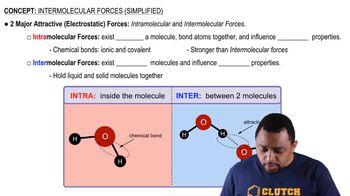
Intermolecular forces are the attractive forces between molecules that influence various physical properties, including viscosity. Stronger intermolecular forces, such as hydrogen bonding or dipole-dipole interactions, typically lead to higher viscosity. Understanding these forces is essential for comparing substances and predicting their flow behavior under different conditions.
추천 영상:
가이드 코스
01:59
Intermolecular vs Intramolecular Forces