Ch.11 - Liquids & Phase Changes
McMurry - Chemistry 8th Edition
McMurry8th EditionChemistryISBN: 9781292336145당신이 사용하는 게 아니라요?교과서 변경
11장, 문제 49

How much energy in kilojoules is released when 25.0 g of ethanol vapor at 93.0 °C is cooled to -11.0 °C? Ethanol has mp = -114.1 °C, bp = 78.3 °C, ΔHvap = 38.56 kJ>mol, and ΔHfusio#n = 4.93 kJ>mol. The molar heat#capacity is 112.3 J>1K mol2 for the liquid and 65.6 J>1K vapor.

검증된 단계별 안내
1
Calculate the number of moles of ethanol using its molar mass. The molar mass of ethanol (C2H5OH) is approximately 46.07 g/mol.
Since the initial temperature of ethanol vapor is 93.0 °C and it needs to be cooled to -11.0 °C, first calculate the energy released when ethanol vapor is cooled from 93.0 °C to its boiling point, 78.3 °C, using the molar heat capacity of the vapor.
Calculate the energy released during the condensation of ethanol vapor at its boiling point using the given heat of vaporization (ΔHvap).
After condensation, calculate the energy released when the liquid ethanol is further cooled from 78.3 °C to -11.0 °C using the molar heat capacity of the liquid.
Sum up all the energy values obtained in the previous steps to find the total energy released during the entire cooling process.

비슷한 문제에 대한 검증된 영상 답변:

이 영상 해법은 위 문제에 도움이 된다고 튜터들이 추천한 것입니다.
영상 길이:
4m

주요 개념

질문에 올바르게 답하기 위해 반드시 이해해야 하는 핵심 개념들은 다음과 같습니다.

Phase Changes

Phase changes refer to the transitions between solid, liquid, and gas states of matter, which occur at specific temperatures and pressures. In this question, ethanol transitions from vapor to liquid and then to solid as it cools. Understanding the enthalpy changes associated with these phase transitions, such as the heat of vaporization (ΔHvap) and heat of fusion (ΔHfusion), is crucial for calculating the total energy change.
추천 영상:
가이드 코스
01:46
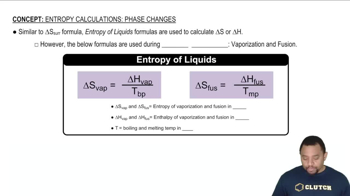
Entropy in Phase Changes

Specific Heat Capacity

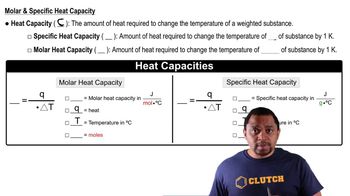
Specific heat capacity is the amount of heat required to raise the temperature of a unit mass of a substance by one degree Celsius (or Kelvin). In this problem, the specific heat capacities for both the vapor and liquid phases of ethanol are provided, which are essential for calculating the energy change during the temperature change of ethanol vapor as it cools down to its melting point.
추천 영상:

Energy Calculations in Thermodynamics

Energy calculations in thermodynamics involve using formulas to quantify heat transfer during physical and chemical processes. In this scenario, the total energy released when cooling ethanol includes contributions from cooling the vapor, condensing it to liquid, cooling the liquid, freezing it to solid, and finally cooling the solid. Each step requires applying the appropriate heat equations, considering mass, specific heat, and enthalpy changes.
추천 영상:
가이드 코스
01:18
First Law of Thermodynamics