Ch.11 - Liquids & Phase Changes
McMurry - Chemistry 8th Edition
McMurry8th EditionChemistryISBN: 9781292336145당신이 사용하는 게 아니라요?교과서 변경
11장, 문제 44

Mercury has mp = -38.8 °C and bp = 356.6 °C. What,if any, phase changes take place under the following condi-tions at 1.0 atm pressure? (a) The temperature of a sample is raised from -30 °C to 365 °C.

검증된 단계별 안내
1
Identify the initial and final temperatures of the mercury sample and compare them with the melting point (mp) and boiling point (bp) of mercury. Initial temperature: -30 °C, Final temperature: 365 °C, mp of mercury: -38.8 °C, bp of mercury: 356.6 °C.
Determine if the initial temperature is above or below the melting point. Since -30 °C is above -38.8 °C, the mercury starts in the liquid phase.
Assess whether the final temperature surpasses the boiling point of mercury. Since 365 °C is above 356.6 °C, the mercury will undergo a phase change from liquid to gas.
Conclude that as the temperature of mercury is increased from -30 °C to 365 °C, it remains in the liquid phase until it reaches its boiling point at 356.6 °C.
State that upon reaching 356.6 °C, the mercury begins to boil and transitions from the liquid phase to the gaseous phase.

비슷한 문제에 대한 검증된 영상 답변:

이 영상 해법은 위 문제에 도움이 된다고 튜터들이 추천한 것입니다.
영상 길이:
1m
도움이 되었나요?

주요 개념

질문에 올바르게 답하기 위해 반드시 이해해야 하는 핵심 개념들은 다음과 같습니다.

Phase Changes

Phase changes refer to the transitions between solid, liquid, and gas states of matter. These changes occur when a substance absorbs or releases energy, typically in the form of heat. For mercury, phase changes will occur at its melting point (-38.8 °C) and boiling point (356.6 °C), where it transitions from solid to liquid and from liquid to gas, respectively.
추천 영상:
가이드 코스
01:46
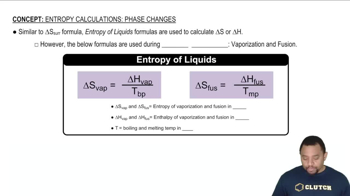
Entropy in Phase Changes

Melting Point and Boiling Point

The melting point is the temperature at which a solid becomes a liquid, while the boiling point is the temperature at which a liquid turns into a gas. For mercury, the melting point is -38.8 °C, meaning it will be in a solid state below this temperature, and the boiling point is 356.6 °C, indicating it will remain a liquid until this temperature is reached at 1.0 atm pressure.
추천 영상:
가이드 코스
04:29
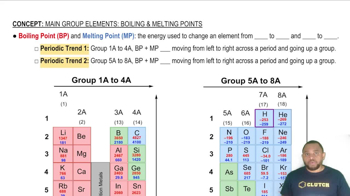
Boiling Point and Melting Point

Effect of Pressure on Phase Changes

Pressure can significantly influence the phase changes of substances. At 1.0 atm, the standard atmospheric pressure, mercury's phase transitions occur at its defined melting and boiling points. Understanding how pressure affects these points is crucial for predicting the state of mercury under varying temperature conditions, as higher pressures can raise boiling points and lower melting points.
추천 영상:
가이드 코스
01:46
Entropy in Phase Changes