Ch.11 - Liquids & Phase Changes
McMurry - Chemistry 8th Edition
McMurry8th EditionChemistryISBN: 9781292336145당신이 사용하는 게 아니라요?교과서 변경
11장, 문제 50

When ethyl alcohol, CH3CH2OH, dissolves in water, how many hydrogen bonds are formed between one ethyl alcohol molecule and surrounding water molecules? Sketch the hydro- gen bonding interactions. (Hint: Add lone pairs of electrons to the structure before drawing hydrogen bonds.)

검증된 단계별 안내
1
Step 1: Draw the Lewis structure of ethyl alcohol, CH3CH2OH. Remember to include all the valence electrons and the lone pairs on the oxygen atom.
Step 2: Identify the hydrogen bond donors and acceptors in ethyl alcohol. Hydrogen bond donors are the hydrogen atoms attached to highly electronegative atoms (like oxygen), and hydrogen bond acceptors are the electronegative atoms with lone pairs of electrons (like oxygen). In ethyl alcohol, the hydrogen atoms attached to the oxygen atom can act as hydrogen bond donors, and the oxygen atom can act as a hydrogen bond acceptor.
Step 3: Draw the Lewis structure of water, H2O. Identify the hydrogen bond donors (the hydrogen atoms) and acceptors (the oxygen atom).
Step 4: Now, draw the hydrogen bonds between the ethyl alcohol and water molecules. A hydrogen bond is represented by a dotted line between the hydrogen bond donor (hydrogen atom) and the hydrogen bond acceptor (oxygen atom).
Step 5: Count the number of hydrogen bonds formed. Remember, each ethyl alcohol molecule can form two hydrogen bonds with water - one from the hydrogen atom of the -OH group in ethyl alcohol to the oxygen atom in water, and another from the hydrogen atom in water to the oxygen atom in the -OH group of ethyl alcohol.

비슷한 문제에 대한 검증된 영상 답변:

이 영상 해법은 위 문제에 도움이 된다고 튜터들이 추천한 것입니다.
영상 길이:
3m
도움이 되었나요?

주요 개념

질문에 올바르게 답하기 위해 반드시 이해해야 하는 핵심 개념들은 다음과 같습니다.

Hydrogen Bonding

Hydrogen bonding is a type of intermolecular force that occurs when a hydrogen atom covalently bonded to a highly electronegative atom, such as oxygen or nitrogen, interacts with another electronegative atom. In the case of ethyl alcohol and water, the hydrogen atoms of the hydroxyl group (-OH) in ethyl alcohol can form hydrogen bonds with the oxygen atoms of water molecules, significantly influencing the solubility and properties of the solution.
추천 영상:
가이드 코스
01:22
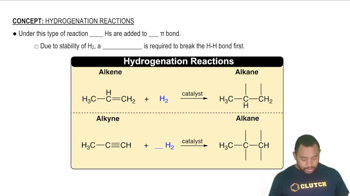
Hydrogenation Reactions

Molecular Structure of Ethyl Alcohol

Ethyl alcohol (CH3CH2OH) consists of a two-carbon chain with a hydroxyl (-OH) functional group. The presence of the hydroxyl group makes ethyl alcohol polar, allowing it to interact favorably with polar solvents like water. Understanding the molecular structure is crucial for predicting how many hydrogen bonds can form between ethyl alcohol and water.
추천 영상:
가이드 코스
01:10
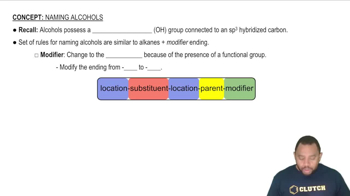
Rules for Naming Alcohols

Lone Pairs of Electrons

Lone pairs of electrons are pairs of valence electrons that are not involved in bonding and are localized on a single atom. In the context of hydrogen bonding, the lone pairs on the oxygen atom of water are essential for forming hydrogen bonds with the hydrogen atom of the hydroxyl group in ethyl alcohol. Recognizing the role of lone pairs helps in visualizing and sketching the hydrogen bonding interactions.
추천 영상:
가이드 코스
00:51
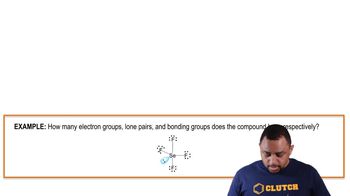
Electron Groups, Lone Pairs, and Bonding Groups Example
관련 실천
교과서 질문
Water at room temperature is placed in a flask connected by rubber tubing to a vacuum pump, and the pump is turned on. After several minutes, the volume of the water has decreased, and what remains has turned to ice. Explain
367
views

교과서 질문
How much energy in kilojoules is needed to heat 5.00 g of ice from -11.0 °C to °30.0 °C? The heat of fusion of water is 6.01 kJ>mol, and the m# olar heat capacity is 36.01 kJ>mol for ice and 75.4 J/K mol2 for liquid water
1016
views
교과서 질문
Benzene has a melting point of 5.53 °C and a boiling point of 80.09 °C at atmospheric pressure. Its density is0.8787 g>cm3 when liquid and 0.899 g>cm3 when solid; it has Tc = 289.01 °C, Pc = 48.34 atm, Tt = 5.52 °C, and Pt = 0.0473 atm. Starting from a point at 200 K and 66.5 atm, trace the following path on a phase diagram. (1) First, increase T to 585 K while keeping P constant. (2) Next, decrease P to 38.5 atm while keeping T constant. (3) Then, decrease T to 278.66 K while keeping P constant. (4) Finally, decrease P to 0.0025 atm while keeping T constant. What is your starting phase, and what is your final phase?
2486
views
교과서 질문
Mercury has mp = -38.8 °C and bp = 356.6 °C. What,if any, phase changes take place under the following condi-tions at 1.0 atm pressure? (a) The temperature of a sample is raised from -30 °C to 365 °C.
821
views
교과서 질문
How much energy in kilojoules is released when 25.0 g of ethanol vapor at 93.0 °C is cooled to -11.0 °C? Ethanol has mp = -114.1 °C, bp = 78.3 °C, ΔHvap = 38.56 kJ>mol, and ΔHfusio#n = 4.93 kJ>mol. The molar heat#capacity is 112.3 J>1K mol2 for the liquid and 65.6 J>1K vapor.
1332
views
1
comments