Which of the following substances would you expect to have
a nonzero dipole moment? Explain, and show the direction
of each.
(a) Cl2O
(b) XeF4
(c) Chloroethane, CH3CH2Cl
(d) BF3
검증된 단계별 안내
1
1. The dipole moment of a molecule depends on its molecular geometry and the difference in electronegativity between the atoms. A molecule will have a nonzero dipole moment if it is polar, meaning it has an uneven distribution of electron density.
2. For (a) Cl2O: The molecule has a bent shape similar to water because of the two lone pairs on the Oxygen atom. The Oxygen atom is more electronegative than the Chlorine atoms, so the dipole moments of the O-Cl bonds do not cancel out, resulting in a net dipole moment. The direction of the dipole moment is from the Chlorine atoms towards the Oxygen atom.
3. For (b) XeF4: The molecule has a square planar geometry. The Fluorine atoms are more electronegative than the Xenon atom, but due to the symmetry of the molecule, the dipole moments of the Xe-F bonds cancel out, resulting in a zero net dipole moment.
4. For (c) Chloroethane, CH3CH2Cl: The molecule is not symmetrical because of the Chlorine atom. The Chlorine atom is more electronegative than the Carbon and Hydrogen atoms, so the dipole moments do not cancel out, resulting in a net dipole moment. The direction of the dipole moment is from the Hydrogen and Carbon atoms towards the Chlorine atom.
5. For (d) BF3: The molecule has a trigonal planar geometry. The Fluorine atoms are more electronegative than the Boron atom, but due to the symmetry of the molecule, the dipole moments of the B-F bonds cancel out, resulting in a zero net dipole moment.
비슷한 문제에 대한 검증된 영상 답변:
이 영상 해법은 위 문제에 도움이 된다고 튜터들이 추천한 것입니다.
영상 길이:
8m
영상 재생:
0 댓글
주요 개념
질문에 올바르게 답하기 위해 반드시 이해해야 하는 핵심 개념들은 다음과 같습니다.
Dipole Moment
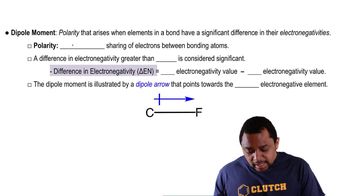
A dipole moment is a measure of the separation of positive and negative charges in a molecule, indicating its polarity. It arises when there is an uneven distribution of electron density, leading to a partial positive charge on one end and a partial negative charge on the other. Molecules with a nonzero dipole moment are polar, while those with a zero dipole moment are nonpolar.
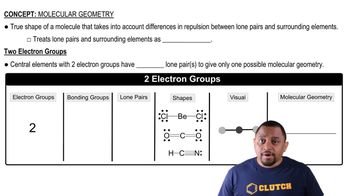
Molecular geometry refers to the three-dimensional arrangement of atoms within a molecule. The shape of a molecule significantly influences its dipole moment; for example, symmetrical molecules may have bond dipoles that cancel each other out, resulting in a nonpolar molecule. Understanding the geometry helps predict whether a molecule will have a nonzero dipole moment.
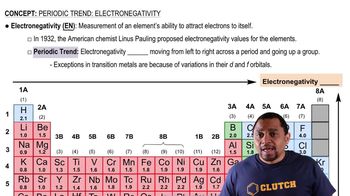
Electronegativity is the tendency of an atom to attract electrons in a chemical bond. Differences in electronegativity between bonded atoms can lead to polar covalent bonds, contributing to the overall dipole moment of the molecule. For instance, in a bond between chlorine and carbon, chlorine's higher electronegativity creates a partial negative charge, influencing the molecule's polarity.


 검증된 단계별 안내
 01:25
01:25